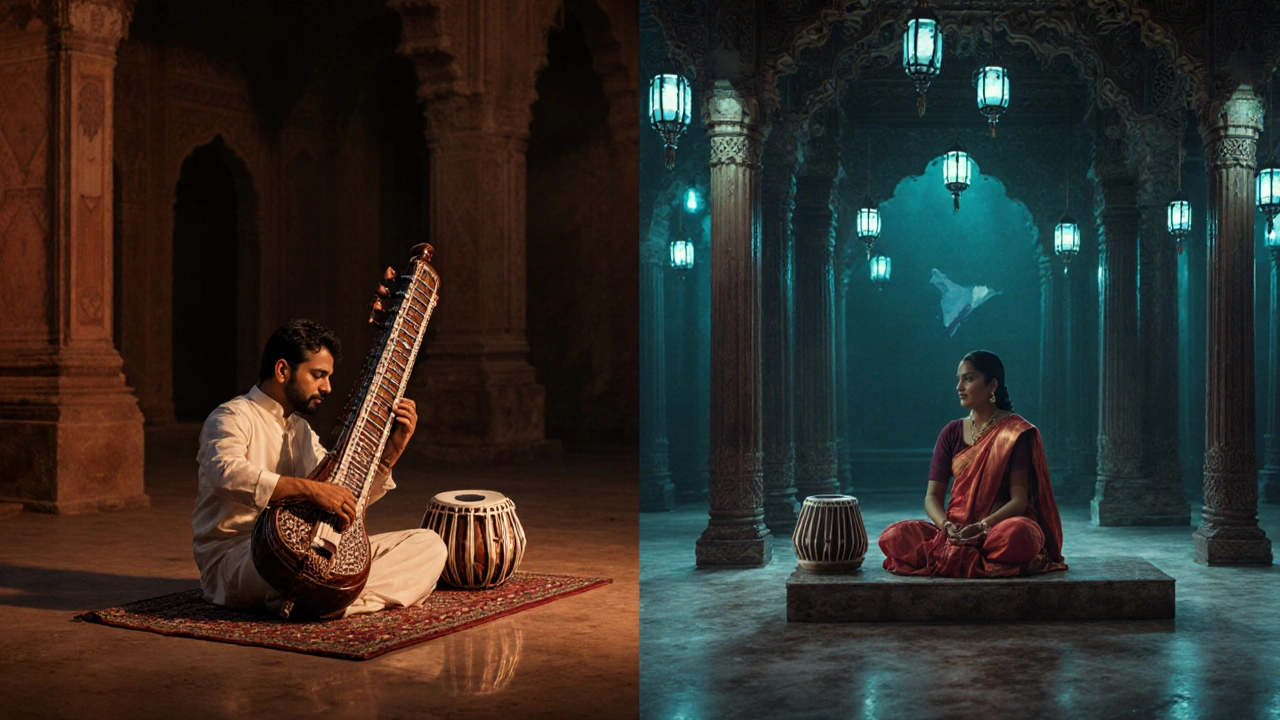
Hindustani vs Carnatic: The Two Pillars of Indian Classical Music
Discover the two main types of Indian classical music-Hindustani and Carnatic-by exploring their history, key elements, instruments, and how they differ.
When you hear the steady clapping of hands in a temple courtyard or the sharp tap of a mridangam during a concert, you’re experiencing Tala, the structured rhythmic cycle that organizes time in Indian music. Also known as tāla, it’s not just a beat—it’s the heartbeat of performance, guiding singers, dancers, and drummers through patterns that can last from a few seconds to over a minute. Unlike Western time signatures, Tala isn’t rigidly measured in bars; it flows with cycles of beats called aksharas, each carrying its own weight, emphasis, and emotional texture.
Tala is the silent architect behind Carnatic music in Tamil Nadu and Hindustani music in the north. In Tamil folk traditions like Karakattam and Theru Koothu, Tala doesn’t just accompany movement—it *is* the movement. Dancers don’t follow the rhythm; they become it. The same cycles you hear in a temple drumming session also echo in village songs where people clap out patterns while working in fields. It’s not random noise—it’s codified, passed down, and deeply tied to identity. Tala connects to other key concepts like Carnatic music, a devotional, temple-rooted classical system from South India, and Hindustani music, the north Indian tradition shaped by courtly and Sufi influences. Both rely on Tala, but they use it differently: Carnatic Tala tends to be more mathematically precise, while Hindustani Tala often bends with improvisation. Then there’s folk music patterns, the simpler, oral-cycle rhythms used in daily life across rural India, which borrow from classical Tala but simplify it for communal participation.
What makes Tala so powerful is how it turns time into something you can feel, not just count. A 16-beat cycle like Adi Tala isn’t just a number—it’s a story told in pulses. One beat might be a deep drum thud, the next a finger snap, then a pause that holds your breath. These patterns are embedded in rituals, festivals, and even lullabies. You’ll find them in the way Tamil families light lamps during Karthigai Deepam, in the footwork of Bharatanatyam dancers, and in the chants of temple priests. The posts below explore how Tala lives beyond the concert hall—in folk songs, in dance, in the silent spaces between beats. Whether you’re curious about why certain rhythms repeat in Tamil Nadu’s street performances or how a single Tala can carry an entire 45-minute raga, you’ll find real examples here. No theory without practice. No rhythm without soul.
Discover the two main types of Indian classical music-Hindustani and Carnatic-by exploring their history, key elements, instruments, and how they differ.