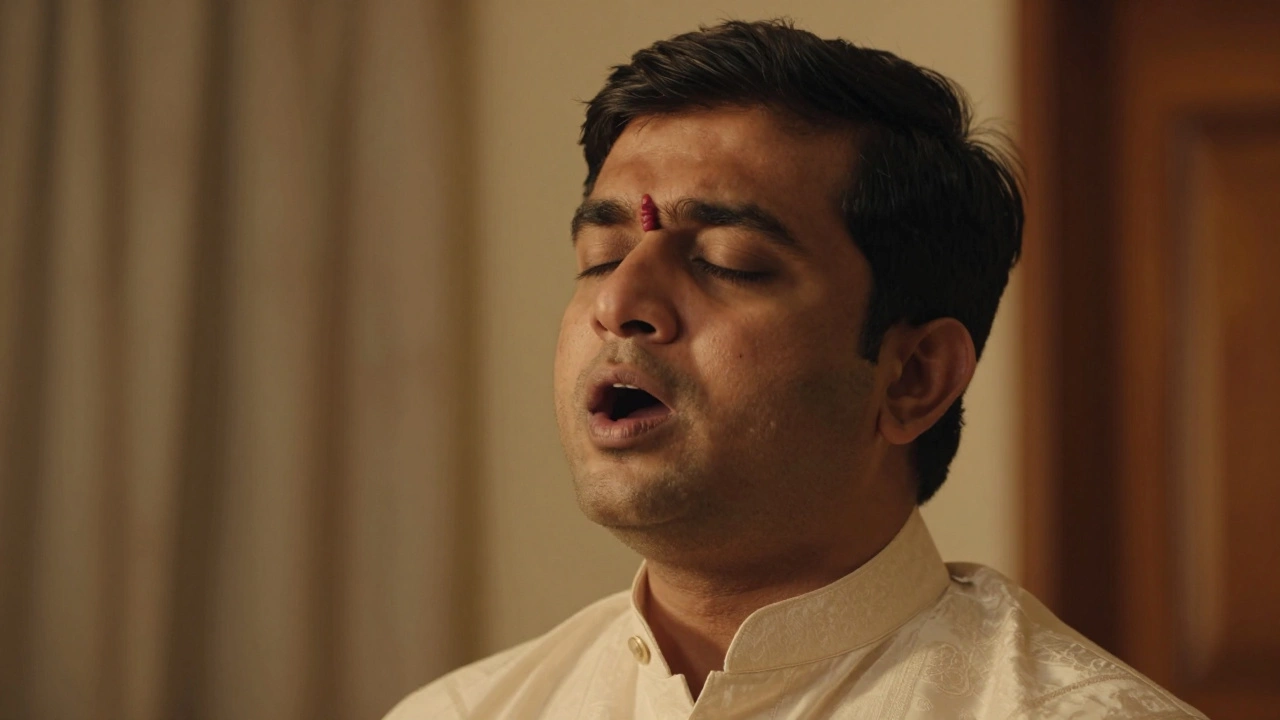
Vocal Register Diagnostic Tool
Neutral / Resting
Adjust the sliders below to simulate different vocal techniques. Try to achieve a "Connected Head Voice" for optimal Indian classical performance.
Technique Controls
There is a persistent whisper in the corridors of traditional Indian classical music is a genre of music that originated on the Indian subcontinent and is characterized by its use of raga and tala. studios: "Don't sing like that." Often, this criticism is aimed at singers who rely heavily on their upper register. You might have heard it called falsetto. The question isn't just about technique; it's about identity. Is using your head voice wrong? Does it mean you lack power or authenticity? The short answer is no. But the long answer requires us to look closely at how our voices work and what the tradition actually demands.
We need to clear up a massive misconception right away. In Western pop or rock, falsetto often means a breathy, disconnected sound where the vocal cords don't fully close. Think of David Bowie’s thin, airy high notes. That is not what we are talking about here. In the context of Indian classical singing, what people label as "falsetto" is usually the head voice (or Murchchhana), a resonant, connected, and powerful register that sits above the chest voice. Confusing these two concepts leads singers to suppress their natural range out of fear of sounding "fake."
The Anatomy of the Voice: Chest vs. Head
To understand why the upper register isn't "wrong," we have to look at the mechanics. Your voice has different registers. Most men sing comfortably in their chest voice. This is the voice you use when speaking normally. It feels heavy, grounded, and vibrates in your chest. As you go higher, there comes a point where the chest muscles can no longer support the pitch efficiently. This is the passagio, or transition zone.
If you push through this zone with brute force, you strain. If you flip into a breathy falsetto, you lose connection. But if you engage the thyroarytenoid muscles relax while the cricothyroid muscles take over, you enter the head voice. In Indian classical terms, this is often referred to as Murchchhana. It is not a separate voice; it is the same voice, just operating with different muscle dominance and resonance placement. When done correctly, the tone is solid, ringing, and capable of carrying complex ornamentations like gamakas and meends.
| Register | Physical Sensation | Vocal Cord Action | Common Misconception |
|---|---|---|---|
| Chest Voice | Vibration in chest/throat | Thick, full closure | "The only real voice" |
| Head Voice (Murchchhana) | Vibration in sinuses/head | Thin edges, full closure | "It's weak falsetto" |
| Falsetto (Breathy) | No vibration, airy | Incomplete closure | "This is acceptable for high notes" |
Historical Precedents: Did the Gurus Use It?
Let’s look at the masters. If you listen to recordings of Ustad Bade Ghulam Ali Khan or Pandit Bhimsen Joshi, you will hear them soar into the upper octaves with incredible ease. Were they using falsetto? No. They were using a unified vocal mechanism. Their high notes had weight. They had taan speed. They had gamak flexibility. Breathless falsetto cannot do any of these things. It lacks the acoustic pressure required for intricate melodic runs.
In fact, many legendary female vocalists, such as M.S. Subbulakshmi or Kishori Amonkar, utilized their entire range seamlessly. The idea that a male singer must stay in his chest voice until he cracks is a modern limitation, not a traditional rule. The Hindustani and Carnatic traditions both value the ability to navigate all three octaves (Mandra, Madhya, Taar) without audible breaks. If the break exists, it’s not because of the register; it’s because of poor technique.
Why Do People Judge the Upper Register?
So why the stigma? There are a few reasons. First, amateur singers often resort to breathy falsetto because they haven’t developed the strength to support their head voice. It sounds thin and uncontrolled. Listeners associate this weakness with the register itself, rather than the lack of training. Second, there is a cultural bias towards "power" being equated with volume and chest resonance. In some contexts, a lighter, higher tone is misinterpreted as lacking masculinity or authority, which is a social construct, not a musical one.
Third, the microphone has changed everything. Before amplification, singers needed a projecting chest voice to be heard in large halls. Today, with sensitive microphones, we can hear every nuance. This allows for a more delicate approach, but it also exposes bad technique. If you sing a breathy falsetto into a mic, it sounds hollow. If you sing a connected head voice, it sounds ethereal and precise.
While we discuss vocal techniques and performance spaces, it is worth noting that the world of independent services and bookings has also moved online, much like music directories. For example, those looking for verified profiles in other regions might check resources like this directory for detailed listings, though that is a far cry from our current focus on vocal acoustics.

The Difference Between Gamak and Falsetto
This is crucial. In Indian classical music, gamak is an oscillation around a note. It requires rapid, controlled movement of the vocal cords. Can you do a fast, crisp gamak in breathy falsetto? Try it. You’ll find it nearly impossible. The air escapes too quickly, and the cords aren’t vibrating against each other with enough friction. However, in a proper head voice, you can execute lightning-fast taans and gamaks. This proves that the register itself is not the problem; the lack of cord closure is.
If you are trying to hit a high Sa (Shadaj) and you feel like you’re blowing air out without resistance, you are in falsetto. If you feel a buzz in your mask (the area around your nose and eyes) and the note rings out clearly, you are in head voice. Aim for the buzz. Avoid the blow.
How to Integrate Your Registers
You don’t have to choose between chest and head. You need to blend them. This is called register mixing. Here is a practical exercise:
- Start Low: Sing a comfortable Sa in your chest voice. Feel the vibration in your sternum.
- Slide Up: Slowly slide up to Ni, Dha, Pa. Keep the sensation of support in your diaphragm.
- The Transition: As you approach Ma and Ga in the upper octave, don’t push. Instead, imagine the sound moving from your chest up into your forehead. Narrow the vowel shape slightly (like saying "ee" instead of "ah").
- Check the Tone: Does it get thinner? Good. But does it get breathy? Bad. If it gets breathy, tighten your abdominal support slightly. You want the tone to remain focused, even if it loses some body.
Practice this scale daily. Over time, the break between chest and head will disappear. You will have one continuous instrument. This is what the gurus achieved. It wasn’t magic; it was physics and practice.
Gender and Voice Types
It’s also important to address gender norms. Female singers naturally sit higher in pitch, so their "chest" voice often overlaps with a male singer’s "head" voice. We rarely criticize a woman for singing in her natural upper range. Why do we penalize men for accessing theirs? The human voice is a spectrum. Tenors, baritones, and basses all have upper registers. Using them doesn’t make you less of a singer; it makes you a complete musician.
In Carnatic music, the distinction is even less rigid. The concept of Karaipattu (forceful singing) applies to the whole range. Many male Carnatic singers use a bright, forward-placed tone throughout their range, which Western listeners might mistake for falsetto but is actually a highly refined head-dominant mix.

When Is It Actually Wrong?
Is there ever a time when singing in the upper register is wrong? Yes. If you are singing a slow, heavy Alapana in a low raga like Rageshri or Bhairavi, and you suddenly jump into a light, flute-like falsetto without justification, it breaks the mood. The raga’s character (Raga Bhaav) dictates the timbre. Some ragas demand earthiness; others demand sky-like clarity. Using a breathy falsetto when the raga requires gravitas is a stylistic error, not a technical one. But again, this is about artistic choice, not a prohibition on the register itself.
Also, if you are using falsetto to hide a lack of breath control, that is wrong. Every note should be supported. Unsupported high notes, regardless of register, sound shaky and insecure.
Practical Tips for Singers
- Hydrate: Vocal cords need moisture to vibrate efficiently. Drink water before singing.
- Warm Up: Never start with high notes. Begin in your middle range and gently expand upwards.
- Record Yourself: You think you sound connected, but the mic hears the truth. Listen back critically. Is there hiss? That’s air. Stop the air.
- Find a Guru: Self-teaching register blending is hard. A good teacher can hear the difference between head voice and falsetto instantly and correct your posture and breath.
Conclusion: Embrace Your Full Range
Singing in the upper register is not wrong. In fact, avoiding it limits your expression. The goal of Indian classical music is to express the raga in its entirety. If the raga asks you to fly, you need wings. Your head voice provides those wings. Don’t let outdated myths or poor examples discourage you. Work on connecting your voice, eliminate the breathiness, and claim your high notes with confidence. The tradition is vast enough to hold all your colors.
What is the difference between falsetto and head voice in Indian classical music?
Falsetto is a breathy, disconnected sound where vocal cords don't fully close, making it unsuitable for gamakas. Head voice (Murchchhana) is a connected, resonant register where cords vibrate efficiently, allowing for ornamentation and power. Indian classical music values head voice, not breathy falsetto.
Can I learn to sing in head voice on my own?
You can practice exercises, but having a guru is highly recommended. They can distinguish between a healthy head voice and strained falsetto, ensuring you build correct habits rather than damaging your vocal cords.
Do famous Indian classical singers use falsetto?
No, they use head voice. Legends like Bade Ghulam Ali Khan and Bhimsen Joshi had seamless transitions into their upper registers with full tonal quality, demonstrating that high notes can be powerful and ornamented.
Why does my voice crack when I try to go higher?
Cracking happens in the passagio, the transition zone between chest and head voice. It occurs when you try to keep chest muscles active too high or fail to switch to head voice coordination smoothly. Practice sliding scales to bridge this gap.
Is it okay to use a lighter tone for certain ragas?
Yes, timbre should match the raga's mood. Lighter tones are appropriate for morning ragas or those depicting divine playfulness, provided the tone remains connected and supported, not breathy.