Raga Mood Finder
Discover Your Raga Connection
Select your context to find the raga that resonates with your emotional state. Based on centuries of musical tradition and scientific understanding.
Raga Insights
Select your time and season to see the raga that matches your emotional state.
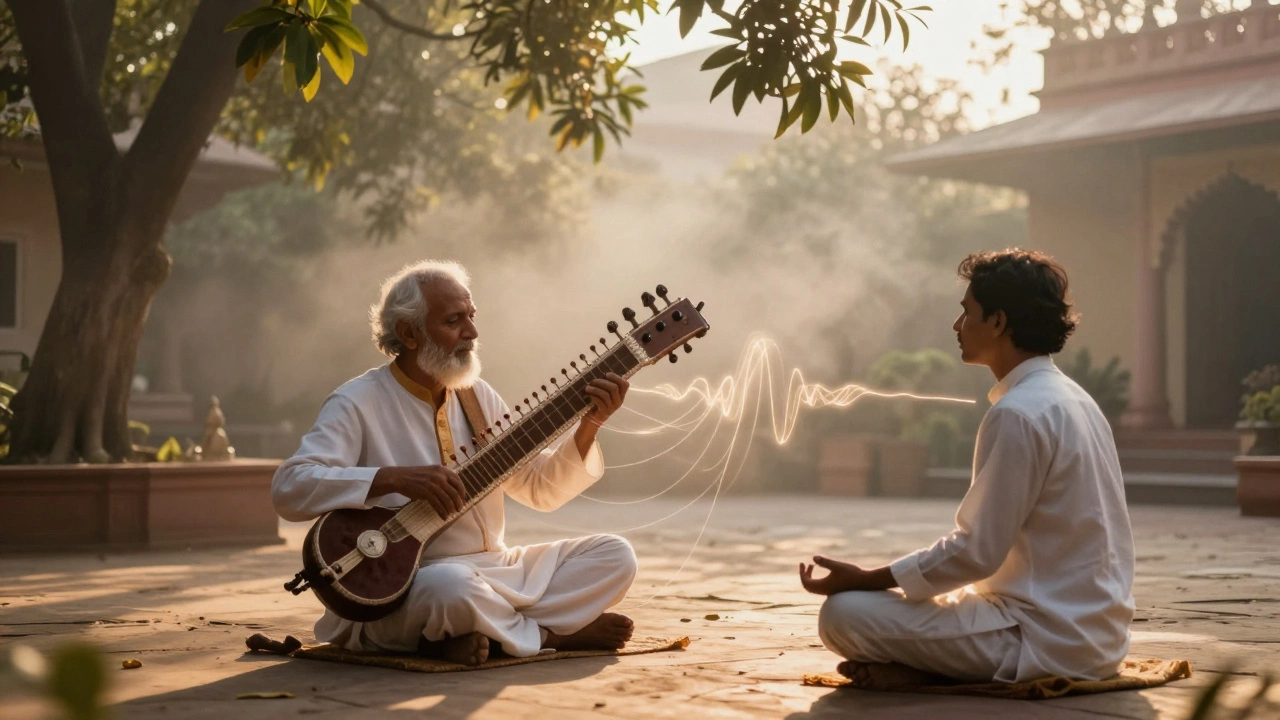
When you hear a sitar glide through a slow raga at dawn, or a veena shimmer like water over stones in the evening, something shifts inside you. It’s not just sound. It’s a quiet pull - like a breath held too long, then released. People ask: Is Indian classical music spiritual? The answer isn’t yes or no. It’s deeper. It’s woven into the very structure of the music, the way it’s taught, the hours it demands, and the silence it leaves behind.
What Makes a Raga More Than a Scale?
Most Western music uses fixed scales - C major, G minor. Indian classical music works differently. A raga isn’t just a set of notes. It’s a living framework with rules, moods, and even times of day it’s meant to be played. Bhairav wakes you up with its solemn gravity. Yaman lulls the mind as dusk falls. Malkauns carries the weight of midnight. These aren’t arbitrary choices. They come from centuries of observation: how light changes, how the body feels at different hours, how emotions rise and settle.
Each note in a raga has a personality. In Hindustani music, the komal (flat) third in Bhoopali doesn’t just sound sad - it aches. In Carnatic music, the gamakas (ornamentations) on a single note can make it cry, laugh, or sigh. This isn’t decoration. It’s emotional engineering. Musicians don’t just play notes. They paint feelings with sound.
The Role of Silence and Space
Western music often fills every second. Indian classical music leaves room - long pauses, breath-like gaps between phrases. That silence isn’t empty. It’s part of the music. Think of it like meditation. You don’t meditate by thinking faster. You meditate by letting thoughts pass. In a raga, the silence between notes lets the listener feel the resonance. The note doesn’t end when the string stops vibrating. It lives in the air. In the chest. In the mind.
There’s a reason masters spend years learning just one raga. It’s not about speed. It’s about depth. A single note, played with perfect control over pitch and vibration, can take 10 minutes to fully unfold. That’s not showmanship. That’s devotion. That’s the spiritual practice.
Connection to Nature and Cosmic Cycles
Indian classical music doesn’t exist in a vacuum. It’s tied to nature. Ragas are classified by time, season, even direction. Deepak, the raga said to light lamps, is played to invoke inner warmth. Shree is performed in spring to mirror renewal. Malhar brings rain - not literally, but emotionally. Listeners report feeling humidity in the air, coolness on their skin. That’s not coincidence. It’s design.
Centuries ago, musicians in royal courts played for kings. But they also played for monks, for farmers, for those who sat alone at dawn. The music was never just entertainment. It was a tool - to calm the mind, to awaken awareness, to align the listener with the rhythm of the world. Even today, many Indian households play morning ragas before breakfast. Not because it’s tradition. Because it works.

The Guru-Shishya Tradition: Learning as Surrender
There’s no certificate in Indian classical music. No exams. No grading. The learning happens through years of listening, copying, and repeating - often in silence. A student sits at the feet of a guru, not to memorize, but to absorb. The guru doesn’t lecture. They play. The student watches the fingers, the breath, the stillness between notes. They learn by becoming still themselves.
This is where spirituality enters. It’s not about being ‘good’ at music. It’s about letting go of ego. A student might spend a year just learning to hold one note. Not to perfect it. To feel it. To understand how a single tone can hold joy, sorrow, longing, peace. That’s not training. That’s transformation.
Music as a Path to Inner Stillness
Many who listen to Indian classical music report feelings they can’t explain - tears without reason, deep calm without effort, a sense of being seen even when alone. That’s not magic. It’s resonance. The human nervous system responds to pitch, rhythm, and silence in predictable ways. Indian classical music taps into that. It slows the breath. Lowers the heart rate. Quiets the mental chatter.
Studies from the National Institute of Mental Health and Neurosciences in Bengaluru have shown that listening to ragas like Bhairavi and Darbari Kanada reduces cortisol levels - the stress hormone - more than silence or ambient music. It’s not just cultural. It’s biological. The structure of the raga, with its slow build, repeated phrases, and intentional pauses, mirrors the rhythm of deep meditation.
It’s Not About Religion - It’s About Experience
Some say Indian classical music is spiritual because it’s linked to Hindu deities. Others point to Sufi influences in the north. But the truth is simpler. You don’t need to believe in Shiva or Allah to feel the pull of a raga. A secular listener, a scientist, a teenager in Brisbane - all can feel the same shift. The music doesn’t ask you to believe. It asks you to listen. Deeply. Slowly. Without judgment.
That’s why it survives. Not because it’s ancient. But because it’s alive. It doesn’t preach. It doesn’t convert. It simply holds space. And in that space, people find what they didn’t know they were looking for: peace. Clarity. A quiet moment that lasts longer than the music itself.
Why This Music Still Matters Today
In a world of endless noise - alerts, ads, streams, updates - Indian classical music offers something rare: stillness with purpose. It doesn’t distract. It doesn’t entertain. It invites. You don’t listen to a raga. You enter it.
That’s why it’s not just music. It’s a practice. A way to return to yourself. You don’t need to be Indian. You don’t need to know the names of the ragas. You just need to sit. Breathe. And let the notes find their way in.
Can Indian classical music be spiritual without religious context?
Yes. While many ragas have historical ties to Hindu or Sufi traditions, the spiritual effect comes from the music’s structure - slow development, intentional silence, microtonal nuances, and emotional depth. These elements work on the nervous system regardless of belief. A person of any background can feel calm, moved, or centered while listening - without any religious framework.
Do you need to be trained to feel the spirituality in Indian classical music?
No. Many people experience deep emotional or meditative responses the first time they hear a raga. Training helps you understand the structure - like recognizing a painter’s brushstroke. But the feeling? That comes from the sound itself. The slow descent of a note, the space between phrases, the way the music lingers - these trigger natural responses in the brain. You don’t need to read music to feel it.
Why do some ragas feel sad, while others feel joyful?
It’s not about the notes alone. It’s about how they’re used. A raga like Malkauns uses a pentatonic scale with lowered tones and long, slow phrases - creating a sense of solitude. Hindol uses playful ornamentation and rising patterns that mimic wind or water. These patterns have been tested over centuries to evoke specific emotional states. It’s not random. It’s intentional design.
Is Indian classical music only for meditation or can it be enjoyed as entertainment?
It can be both. In traditional settings, it’s often a spiritual practice. But modern concerts - even in cities like Sydney or Toronto - draw crowds who come for the beauty, not the ritual. The same raga can be a prayer for one person and a breathtaking performance for another. The music doesn’t change. The listener does. That’s its power.
How is Indian classical music different from other spiritual music, like Gregorian chants or Sufi qawwalis?
Gregorian chants use harmony and repetition to create unity. Sufi qawwalis use rhythm and voice to induce trance. Indian classical music works differently: it uses microtones, silence, and slow evolution. There’s no drumbeat to drive you. No choir to lift you. Instead, it invites you inward - one note at a time. It doesn’t pull you out of yourself. It helps you return to yourself.