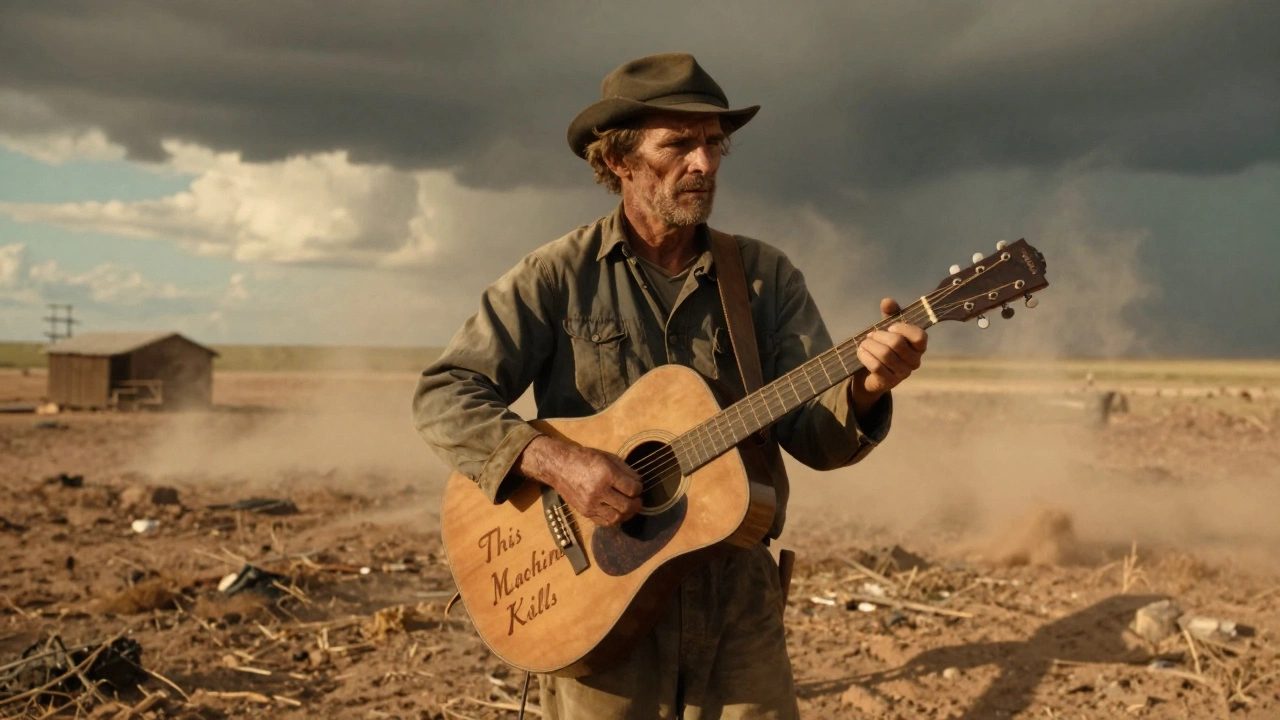
Woody Guthrie: The Folk Music Timeline
Explore the journey from the Dust Bowl to the Folk Revival.
The Beginning in Oklahoma
Woody Guthrie is born in Okemah, Oklahoma. His early life is shaped by financial struggle and his mother's mental illness, planting the seeds for his empathy toward the working class.
The Dust Bowl & Migration
Guthrie joins thousands fleeing the ecological disaster of the Dust Bowl. He moves west to California, where he witnesses the exploitation of migrant workers, fueling his political awakening.
This Land Is Your Land
He writes "This Land Is Your Land" as a counterpoint to "God Bless America," aiming to acknowledge both the beauty of the US and the private property signs keeping poor people out.
Dust Bowl Ballads
Guthrie records his famous album documenting the hardships of displaced farmers. Songs like "Do Re Mi" give a voice to the suffering of the working class.
Huntington’s Disease
Guthrie begins suffering from Huntington’s disease, a progressive genetic disorder. Despite his declining health, he continues to write, draw, and inspire those around him.
Passing the Torch to Dylan
A young Bob Dylan visits Guthrie in the hospital. This meeting teaches Dylan that a singer can be a witness and an activist, sparking the Greenwich Village folk scene.
Father of Folk Music
Guthrie's influence echoes through civil rights anthems, punk rock ethics, and modern hip-hop. He proved that music doesn't need perfect pitch—just something worth saying.
When you hear the word "folk," what comes to mind? Maybe it’s the sound of a lone acoustic guitar, or perhaps a story about hard times told in simple verses. If you are asking who is the father of American folk music, the answer isn’t just one name-it’s a lineage. But if we have to pick the figure who defined the spirit, the politics, and the very sound of modern American folk, that person is Woody Guthrie.
Guthrie didn’t invent folk songs. People have been singing about their lives for centuries. But he changed how those songs were used. He turned folk music into a weapon for social change. Before him, folk was often seen as old-fashioned or purely entertainment. After him, it became a voice for the voiceless.
The Man Behind the Legend: Who Was Woody Guthrie?
Woody Guthrie was an American singer-songwriter who produced over 3,000 songs, including 'This Land Is Your Land' and many Dust Bowl ballads. Born in Okemah, Oklahoma, in 1912, his life was shaped by hardship from the start. His mother suffered from mental illness, and his family struggled financially during the Great Depression.
These early struggles weren’t just background noise; they were the fuel for his art. When the Dust Bowl hit in the 1930s, destroying crops and forcing families off their land, Guthrie joined them. He moved west to California, hoping for work in the orchards. Instead, he found exploitation and poverty among migrant workers.
This experience birthed his most famous album, Dust Bowl Ballads. These weren’t polished studio tracks. They were raw, angry, and honest accounts of people being treated like dirt-literally and figuratively. Songs like "Do Re Mi" and "Pretty Boy Floyd" gave a face to the suffering of the working class. This connection between personal struggle and public songwriting is what earned him the title of the father of American folk music.
Why He Is Called the Father of American Folk Music
You might wonder why Guthrie gets this specific title when there were other great singers before him, like Lead Belly or Pete Seeger. The difference lies in intent and legacy.
- Music as Activism: Guthrie famously wrote "This Machine Kills Fascists" on his guitar. He believed music had a job to do: to fight injustice. He didn’t just sing pretty melodies; he sang truth.
- Accessibility: He kept his lyrics simple and direct. Anyone could understand them. This made folk music accessible to ordinary people, not just elites or academics.
- Influence on Future Generations: Perhaps his biggest claim to fame is inspiring the next wave of musicians. Without Guthrie, the folk revival of the 1960s might never have happened.
His approach democratized the genre. He showed that you didn’t need perfect pitch or expensive instruments to make an impact. You just needed something worth saying.

The Bridge to the 1960s Folk Revival
To understand Guthrie’s importance, you have to look at who listened to him. In the late 1940s and early 1950s, a young man named Bob Dylan was a legendary singer-songwriter who revolutionized popular music with his poetic lyrics and fusion of folk, rock, and blues. Dylan visited Guthrie in the hospital when Guthrie was dying from Huntington’s disease. That visit changed everything.
Dylan later said that meeting Guthrie taught him that a singer could be more than just a performer. A singer could be a witness. This lesson fueled the Greenwich Village folk scene in New York City. Artists like Joan Baez, Phil Ochs, and Pete Seeger picked up where Guthrie left off.
| Artist | Era | Key Contribution | Signature Style |
|---|---|---|---|
| Woody Guthrie | 1930s-1960s | Social protest songs; Dust Bowl narratives | Raspy voice, simple chords, political lyrics |
| Pete Seeger | 1940s-2010s | Popularizing folk standards; activism through performance | Clear tenor, banjo mastery, communal singing |
| Bob Dylan | 1960s-Present | Literary lyricism; bridging folk and rock | Harmonica accompaniment, surreal imagery, electric transition |
This table shows how Guthrie laid the groundwork. While Seeger helped organize the movement and Dylan expanded its artistic boundaries, Guthrie provided the moral compass. He proved that folk music could survive industrialization and still speak to the human condition.
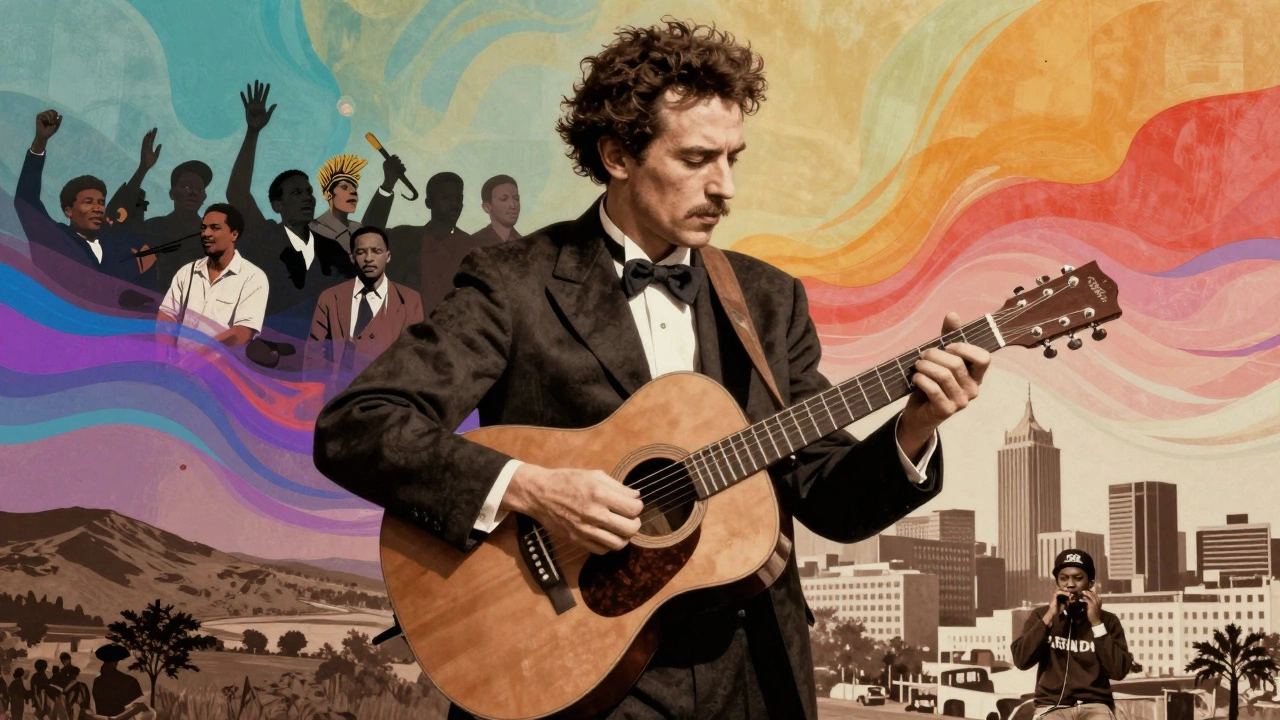
Beyond the Guitar: Guthrie’s Literary Impact
We often think of folk music as just audio, but Guthrie was also a writer. He filled notebooks with poems, stories, and sketches. His book Bound for Glory offers a firsthand account of the migration from Oklahoma to California. It reads less like a memoir and more like a documentary novel.
This literary side is crucial because it shows that folk music is rooted in storytelling. Long before recording technology, people passed down history through song. Guthrie respected that tradition. He didn’t try to create new genres out of thin air; he updated an ancient method of communication for the modern age.
He collected traditional tunes and rewrote the lyrics to fit contemporary issues. For example, "This Land Is Your Land" started as a response to Irving Berlin’s "God Bless America." Guthrie felt Berlin’s song was too patriotic without acknowledging the reality of private property signs and poverty. His version was a gentle correction-a reminder that the country belonged to everyone, not just the wealthy.
The Enduring Legacy of Woody Guthrie
Today, you can hear Guthrie’s influence everywhere. It’s in the protest songs of the civil rights movement. It’s in the punk rock ethos of DIY ethics. It’s even in the spoken-word poetry of modern hip-hop artists who sample his tracks.
The Woody Guthrie Center in Tulsa, Oklahoma, preserves his archive. Visitors can see his guitars, his manuscripts, and listen to his recordings. It serves as a testament to the idea that one person’s voice, amplified by a simple instrument, can shape a nation’s culture.
So, when you ask who the father of American folk music is, remember that it’s not just about musical technique. It’s about attitude. Guthrie taught us that music should matter. It should reflect our joys, our sorrows, and our fights. In doing so, he didn’t just write songs; he wrote the blueprint for American cultural identity.
Did Woody Guthrie write "This Land Is Your Land"?
Yes, Woody Guthrie wrote "This Land Is Your Land" in 1940. Originally titled "God Blessed America for Me," he created it as a counterpoint to "God Bless America," aiming to highlight both the beauty of the US and the inequalities faced by its citizens.
What illness did Woody Guthrie suffer from?
Woody Guthrie suffered from Huntington's disease, a progressive genetic disorder that causes the degeneration of nerve cells in the brain. He was diagnosed in the late 1940s and spent much of his later life in hospitals, continuing to write and draw until he could no longer do so.
How did Woody Guthrie influence Bob Dylan?
Guthrie influenced Dylan by demonstrating that folk music could be a vehicle for serious social commentary. Dylan visited Guthrie in the hospital as a teenager, an experience that solidified his commitment to using songwriting as a form of activism and storytelling.
What are Dust Bowl ballads?
Dust Bowl ballads are a collection of songs written by Woody Guthrie in the 1940s that describe the hardships of farmers displaced by the Dust Bowl ecological disaster. They detail the journey from Oklahoma to California and the struggles of migrant workers.
Is Pete Seeger considered the father of folk music?
While Pete Seeger is a giant in the folk world and crucial to the mid-20th century revival, Woody Guthrie is typically cited as the "father" due to his earlier pioneering work in merging folk traditions with radical political activism and his profound influence on subsequent generations like Dylan.