Bhimbetka Age Calculator
Estimate Painting Age
Calculate approximate age of Bhimbetka paintings based on mineral deposit thickness
Mineral deposits (calcite) form at approximately 1 mm per 1,000 years in Bhimbetka's rock shelters.
How This Works
The calculator uses the mineral deposit growth rate (1mm per 1,000 years) mentioned in the article. This is based on uranium-thorium dating of calcite crusts that formed over the paintings. For example, a 10mm deposit would indicate the painting is approximately 10,000 years old.
The world’s oldest known art isn’t in a European cave or a Mediterranean temple. It’s on the rocky cliffs of central India, where handprints and animal figures have survived for over 30,000 years. These aren’t doodles or decorations-they’re the first recorded attempts by humans to capture their world, their beliefs, and their daily lives. The rock shelters of Bhimbetka, tucked into the Vindhya Hills, hold the oldest continuous record of human artistic expression on Earth.
What Makes Bhimbetka the Oldest Art Site?
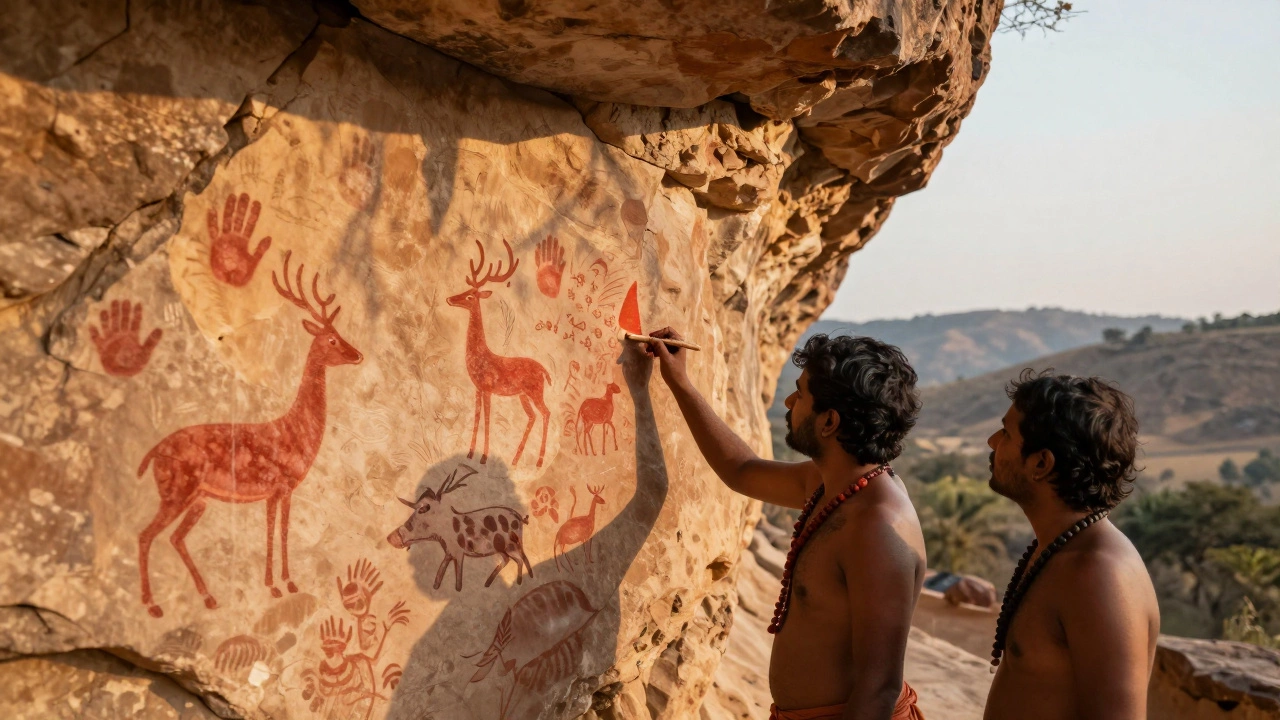
More than 700 rock shelters have been found in Bhimbetka, and nearly 400 of them contain paintings. The earliest ones, dated to around 30,000 years ago, use natural pigments-red ochre, white clay, charcoal, and plant juices-applied with fingers, brushes made from animal hair, or even blown through hollow bones. These aren’t abstract symbols. They show hunting scenes: men with bows chasing deer, wild boars, and antelope. There are elephants, tigers, and rhinos, all rendered with surprising accuracy for a time before written language.
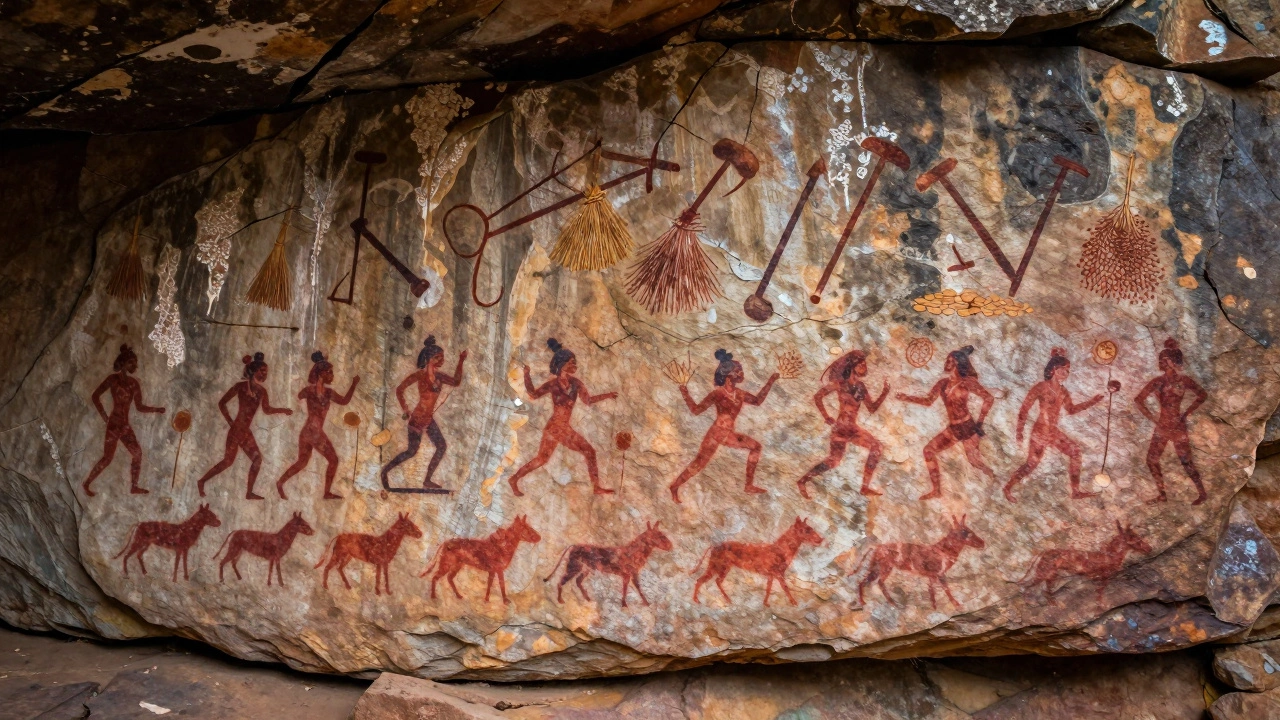
What sets Bhimbetka apart isn’t just its age. It’s the continuity. Unlike other ancient sites that show one burst of activity, Bhimbetka’s paintings span 10,000 years. Later layers show different styles: more complex figures, dancing humans, group rituals, and even early depictions of agriculture. The art evolved as the people did-from hunter-gatherers to early farmers. That’s a rare, unbroken visual timeline of human life.
How Was the Age Confirmed?
Scientists didn’t just guess how old these paintings were. They used multiple methods. One technique, called uranium-thorium dating, measured the mineral deposits that formed *over* the paint. These thin crusts, called calcite, built up slowly over millennia. By dating the layer *on top* of the painting, researchers could tell the art had to be older than that layer. Some calcite deposits were dated to 29,000 years ago, meaning the painting underneath had to be older.
Another clue came from the pigments themselves. The red ochre used in the earliest paintings matches the type found in other sites from the same period across South Asia. Carbon dating of organic material found in the same sediment layers-like charred wood from ancient campfires-also aligned with the painting dates. No other site on Earth has such a clear, multi-method confirmation of art dating back over 30,000 years.
Why Did Early Humans Paint on Rocks?
It wasn’t just decoration. These paintings were part of survival. Many scenes show coordinated hunts-groups of men surrounding prey, using spears and traps. That suggests the art may have been used to teach younger hunters how to track and kill animals. Others show rituals: people in masks, dancers around fire, figures with raised arms. These might represent spiritual practices, possibly connected to animal spirits or seasonal cycles.
Some shelters have clusters of paintings that seem to tell stories. One panel shows a man with a bow, a wounded deer, and another man carrying a child. Is this a hunting success? A tragedy? A myth passed down? We can’t know for sure, but the detail suggests these weren’t random marks. They were meaningful. They carried knowledge, memory, and meaning across generations.
How Does It Compare to Other Ancient Art?
People often think of Lascaux in France or Altamira in Spain when they think of ancient art. Those caves are stunning, but they’re younger-around 17,000 to 20,000 years old. Bhimbetka’s earliest paintings are more than 10,000 years older. The Chauvet Cave in France, with its lions and rhinos, is impressive, but it’s still 12,000 years younger than Bhimbetka’s oldest work.
Even the oldest known figurative art from Indonesia-depictions of a pig on Sulawesi, dated to about 45,500 years ago-isn’t part of a continuous tradition like Bhimbetka. That painting is a single image. Bhimbetka is a library. It shows how art changed over millennia. It shows the same people, or their descendants, returning again and again to the same walls, adding to what came before.
Who Made These Paintings?
They were made by early Homo sapiens living in the region long before the Indus Valley Civilization, before the Vedic period, even before agriculture took hold in South Asia. These were nomadic hunter-gatherers, moving with the seasons, living off wild grains, fruits, and game. They didn’t have pottery, metal tools, or writing. But they had imagination. They had the urge to record what mattered to them.
Archaeologists believe these groups were ancestors to modern tribal communities in central India, like the Bhil and Gond people. Some of these groups still live near Bhimbetka today. Their folk art, dances, and oral stories echo the same themes: animals, nature, spirits, and community. The connection isn’t proven, but it’s hard to ignore.
Why Was It Only Discovered in the 20th Century?
Bhimbetka wasn’t hidden-it was overlooked. For centuries, local villagers knew about the caves. They used them for shelter, stored grain in them, even held small rituals. But no one thought the paintings were ancient art. They were just ‘old drawings’-something that had always been there.
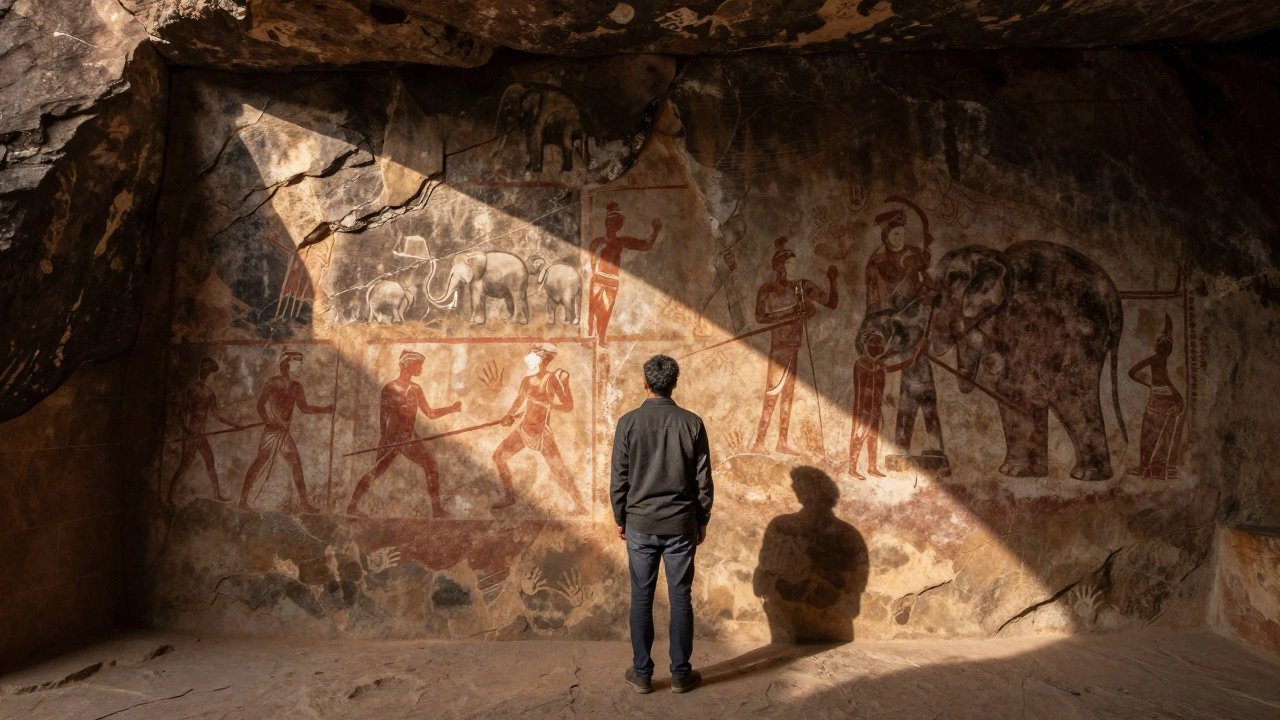
It wasn’t until 1957 that archaeologist V.S. Wakankar, traveling by train, noticed the rock shelters from the window. He got off, climbed up, and saw what others had missed: paintings that looked too deliberate, too consistent to be recent. He returned with a team, and within a few years, Bhimbetka was recognized as one of the most important archaeological sites in the world. In 2003, UNESCO made it a World Heritage Site.
What Can We Learn From This?
Bhimbetka tells us that art isn’t a luxury. It’s as old as language, as old as memory. It’s how humans made sense of their world before they could write it down. These paintings show that even 30,000 years ago, people cared about more than food and shelter. They cared about stories. They cared about connection-to each other, to animals, to the land.
Modern art galleries display abstract canvases and digital installations. But the first art was simple: a hand pressed against stone, a line drawn to show a running deer. It was functional, emotional, and deeply human. That’s why Bhimbetka matters. It’s not just old. It’s the origin point of everything that came after.
Can You Visit Bhimbetka Today?
Yes. The site is protected and open to visitors. The Indian Archaeological Survey maintains a museum nearby with replicas of the paintings, tools found at the site, and explanations of the dating methods. The actual rock shelters are accessible via walking trails. Guides explain the different layers of paintings and how to spot the oldest ones-usually the ones with the simplest shapes, faded reds, and no outlines.
Don’t expect polished exhibits. Bhimbetka isn’t a theme park. It’s raw, real, and quiet. You stand where ancient people stood. You look at the same cliffs they painted. And for a moment, you’re not looking at history-you’re looking at the first human voice.
Is Bhimbetka the oldest art in the world?
Yes, Bhimbetka holds the oldest known *continuous* series of rock paintings, dating back over 30,000 years. While a single pig painting in Indonesia is older (about 45,500 years), it’s an isolated image. Bhimbetka shows thousands of paintings made over 20,000 years, making it the oldest ongoing artistic tradition.
What materials did ancient Indians use for their paintings?
They used natural pigments: red ochre (iron oxide) for red, white clay or chalk for white, charcoal for black, and plant juices for yellow and green. These were mixed with water, animal fat, or plant sap to make paint. Brushes were made from chewed twigs or animal hair, and some colors were applied by blowing pigment through hollow bones.
Are there other ancient art sites in India?
Yes, but none as old or as extensive. Sites like Adamgarh in Madhya Pradesh, Kupgal in Karnataka, and the rock shelters of Kurnool in Andhra Pradesh also have prehistoric paintings. But Bhimbetka is the largest, best-preserved, and most studied. It’s the only one with confirmed dates stretching back over 30,000 years.
Why are the paintings still visible after so long?
The rock shelters provided natural protection from rain and sun. The paintings were made on hard sandstone surfaces, and the pigments bonded deeply with the rock. Over time, a thin layer of mineral crust formed over them, sealing them in. This natural varnish helped preserve the colors for tens of thousands of years.
Do modern Indian tribes still create art like this?
Yes. Tribal groups like the Bhil and Gond still paint their homes and bodies with similar red and white pigments. Their motifs-animals, spirals, dotted patterns-look strikingly similar to the ancient Bhimbetka designs. While not identical, the visual language and symbolic themes suggest a deep cultural continuity.