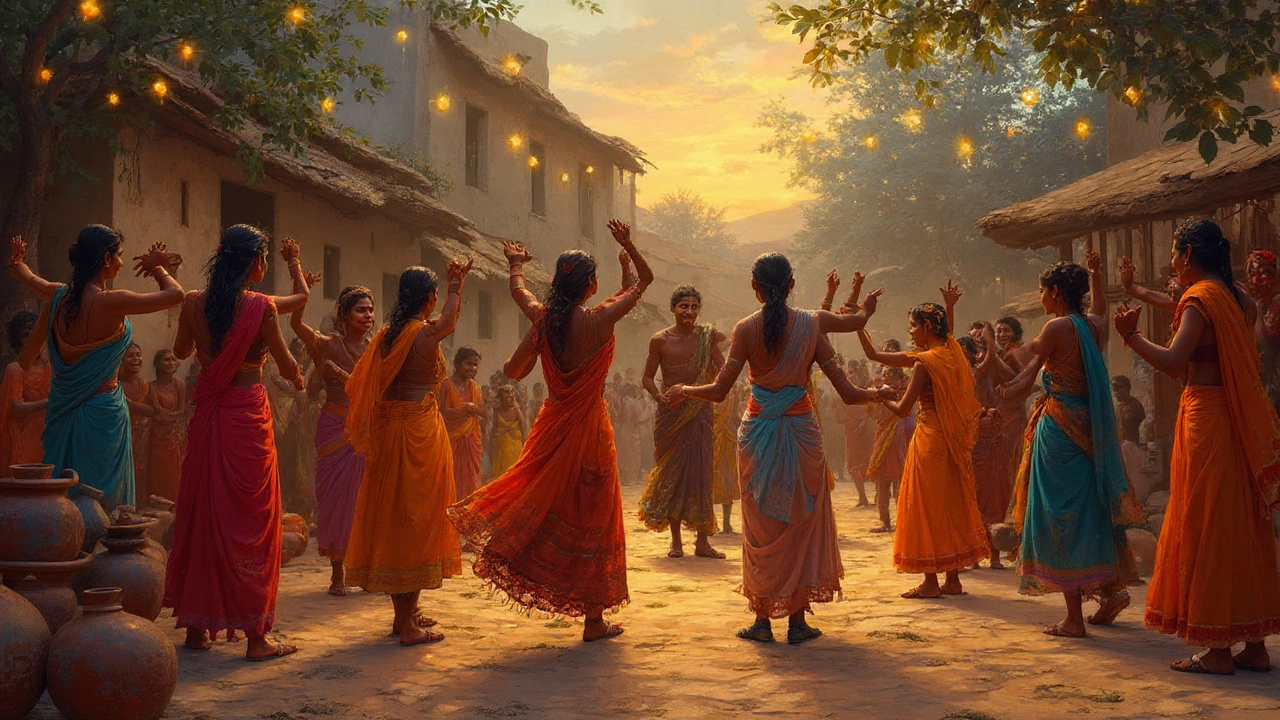
Do Any Countries Really Not Dance? Culture, Beliefs, and Surprising Facts
Are there actually countries where people don't dance? Discover how dance is tied to culture and explore why some societies resist or restrict it.
When you see people moving in rhythm under a temple lamp or around a bonfire, you're not just watching a performance—you're witnessing world dance customs, deeply rooted cultural practices where movement carries meaning far beyond entertainment. These aren't random steps; they're inherited languages passed down through generations, tied to religion, seasons, rites of passage, and community identity. In Tamil Nadu, Karakattam, a dance where performers balance pots on their heads while dancing to drum beats honors the rain goddess. In Alabama, ring shouts, a call-and-response dance with spiritual roots in African American communities preserve memory through step and song. And in Punjab, Bhangra, a high-energy dance born from harvest celebrations still echoes with the pulse of the land.
World dance customs don’t exist in a vacuum. They’re shaped by what people believe, fear, celebrate, or mourn. A dance might be a prayer, a warning, a courtship ritual, or a way to mark the changing seasons. In India, many dances begin as temple offerings—Theru Koothu, a folk theater form from Tamil Nadu that blends dance, music, and storytelling to invoke deities—and later become public festivals. Even dances that look like pure fun, like the Sioux grass dance, where performers mimic the movement of tall grass in the wind with flowing regalia, carry spiritual symbolism tied to nature and ancestors. These aren’t just performances. They’re living archives.
What makes world dance customs powerful is how they connect body, belief, and place. You won’t find the same steps in a village in Kerala and one in Kentucky, but you’ll find the same purpose: to belong, to remember, to honor. Some dances are performed only by women. Others are reserved for elders. Some are banned, then revived. Others changed shape when communities moved abroad. The rhythm of a dance often outlives the language spoken around it. And that’s why these traditions matter—they’re not relics. They’re active threads in the fabric of daily life.
Below, you’ll find real stories from cultures around the world—some familiar, some surprising. You’ll learn why certain steps are forbidden, how music shapes movement, and what happens when a dance crosses borders. No theory. No fluff. Just the truth behind the steps.
Are there actually countries where people don't dance? Discover how dance is tied to culture and explore why some societies resist or restrict it.