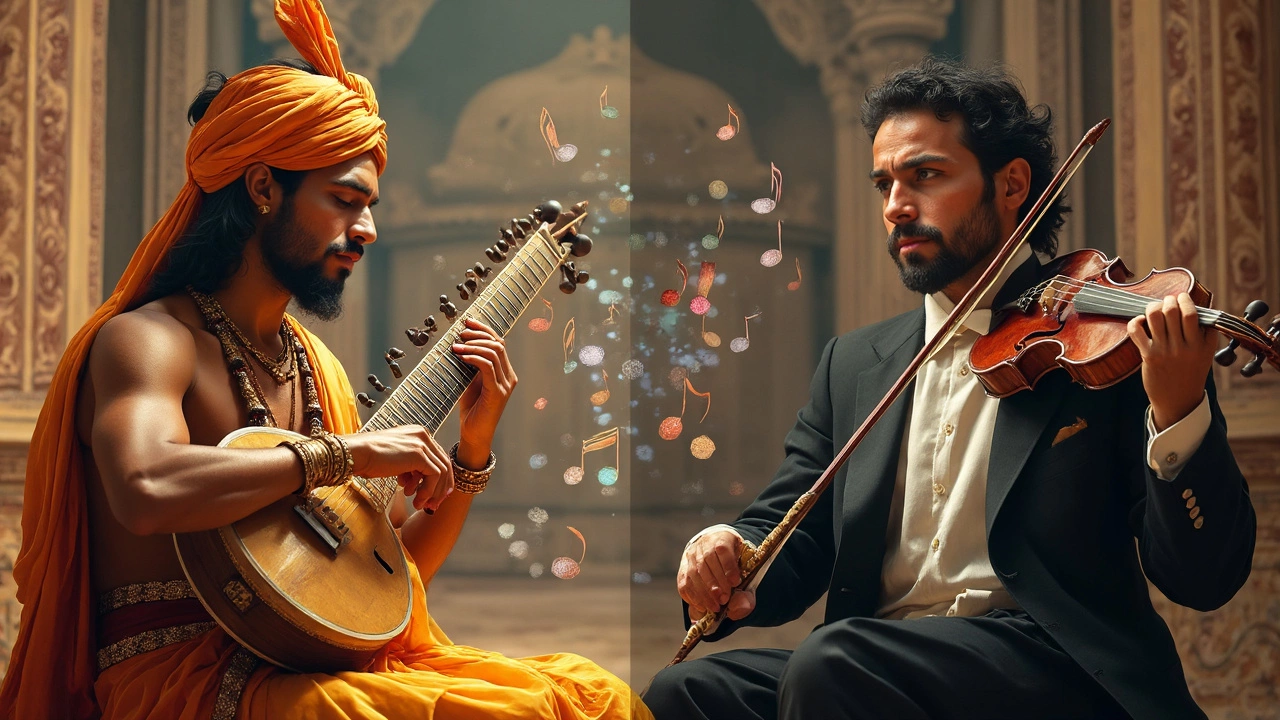
Rhythm in Tamil Culture: Music, Dance, and Daily Life
When you think of rhythm, the steady pulse that moves bodies, voices, and instruments in Tamil culture. Also known as tala, it’s not just timekeeping—it’s the heartbeat of tradition. You hear it in the clatter of ankle bells during Karakattam, in the drumbeats of Thiruvathirakali, and even in the rhythmic chants of temple priests. This isn’t background noise. It’s the structure behind every expression, the invisible thread tying together prayer, celebration, and work.
Rhythm in Tamil culture doesn’t live only on stage. It lives in the kitchen, where women pound rice to the beat of a mortar and pestle. It lives in the fields, where farmers sing work songs synced to the swing of their sickles. And it lives in bol banao, a folk vocal tradition using nonsense syllables to carry emotion and timing. Also known as solfa syllables, this isn’t random noise—it’s a coded language of pulse, passed down through generations without sheet music. You won’t find it in Western music theory, but you’ll feel it in every step of Bharatanatyam, where each toe tap lands like a word in a spoken poem. Rhythm here isn’t measured in beats per minute—it’s measured in breath, in devotion, in the rhythm of life itself.
It’s also what connects Tamil music to its deeper roots. Unlike Hindustani music, which leans into improvisation and emotional flow, Carnatic music—born in the temples of Tamil Nadu—holds rhythm as sacred. The tala, the cyclic rhythmic framework. Also known as rhythmic cycle, it’s the backbone of every composition, from a simple krithi to a complex varnam. A single tala can have 108 beats, and a skilled performer doesn’t just count them—they feel them in their bones. That’s why you’ll hear stories of musicians losing track of time during a concert, not because they’re lost, but because the rhythm pulled them into another state entirely.
And it’s not just about performance. Rhythm is how Tamil communities remember their past. When elders teach children to clap along to folk songs, they’re not just teaching music—they’re teaching identity. The same pulse that drives Theru Koothu performances also echoes in the chants of village festivals. Even today, in cities like Madurai and Coimbatore, you’ll find young dancers practicing for hours, not to win competitions, but to stay connected to something older than their smartphones.
What you’ll find below isn’t a list of articles about rhythm alone. It’s a collection of stories where rhythm is the hidden force—whether it’s in the wordless chants of Tamil folk singers, the drum patterns of temple rituals, or the way Diwali lights flicker to the beat of a dholak. Some posts explain why certain songs use nonsense syllables. Others show how dance moves match ancient time cycles. And a few reveal how rhythm quietly holds Tamil culture together, even when everything else changes.