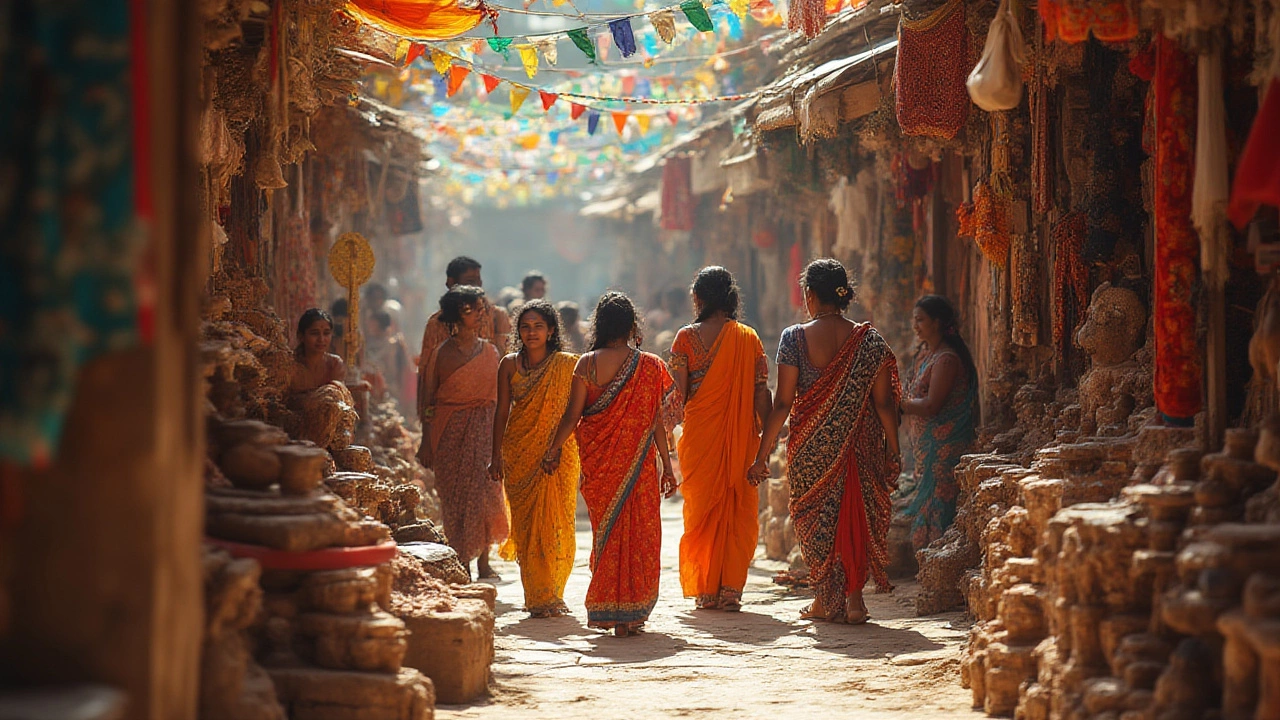
Maharashtra Art: Exploring the Diverse Heritage of Maharashtra Art and Culture
Discover the vibrant world of Maharashtra's art—its folk painting, sculpture, handicrafts, and unique traditions shaped by history, local life, and festive spirit.
When you see a Warli painting, a traditional form of tribal art from Maharashtra, India, using white pigment on mud walls to depict daily life, rituals, and nature through basic geometric shapes. Also known as Warli art, it’s not just decoration—it’s a visual language passed down for centuries by the Warli tribe. While the art form originated in the tribal regions north of Mumbai, Pune has become a key hub where Warli paintings are studied, preserved, and shared with wider audiences—making it one of the most visible faces of tribal art in modern India.
Warli art doesn’t use brushes or complex tools. Artists use a chewed stick dipped in rice paste to draw circles, triangles, and lines that represent people, animals, trees, and the sun. A circle might be the sun or a woman, a triangle could be a mountain or a man, and two triangles joined at the tip form a woman in traditional dress. These symbols aren’t random—they follow rules passed through generations. The art often shows scenes of harvest, dance, weddings, or village life, with figures arranged in rhythmic patterns that echo the pulse of community living. You won’t find perspective or shading here. That’s not the point. Warli art is about connection—to land, to ancestors, to the rhythm of nature.
What makes Warli painting stand out isn’t just its look—it’s how it’s still alive. Unlike many folk arts that faded with modernization, Warli art was revived in the 1970s when artists like Jivya Soma Mashe brought it into galleries and schools. Today, you’ll find Warli paintings on canvas, paper, and even clothing in Pune’s art markets and cultural centers. Local workshops teach the technique to students, and NGOs help tribal artists earn fair income by selling their work. It’s not a museum piece—it’s a living tradition adapting without losing its soul.
Warli art also connects deeply to other forms of Indian folk expression. Like Tamil folklore, the oral and visual traditions of Tamil Nadu that include dance, music, and ritual storytelling, Warli art tells stories without words. It shares roots with Bol banao, the rhythmic, nonsense singing in Indian folk music that carries emotion through sound, not lyrics—both use repetition, pattern, and simplicity to convey deep meaning. And like the blue skin of Indian gods, a symbolic color in Hindu art representing infinity and divine power, the white-on-brown palette of Warli isn’t accidental—it’s spiritual. The earthy background is the land; the white lines are the spirit moving through it.
So if you’ve seen a Warli painting in Pune—on a wall, a tote bag, or a poster—you’re looking at more than art. You’re seeing a quiet resistance to homogenization. A way for people who’ve been left out of mainstream history to say: we exist, we remember, we create. The posts below explore how this art form connects to broader themes in Indian culture—from ritual symbolism to the survival of folk traditions in urban spaces. Whether you’re curious about its origins, its symbols, or how it’s being kept alive today, you’ll find real stories here—not just facts, but voices from the villages that made this art.
Discover the vibrant world of Maharashtra's art—its folk painting, sculpture, handicrafts, and unique traditions shaped by history, local life, and festive spirit.