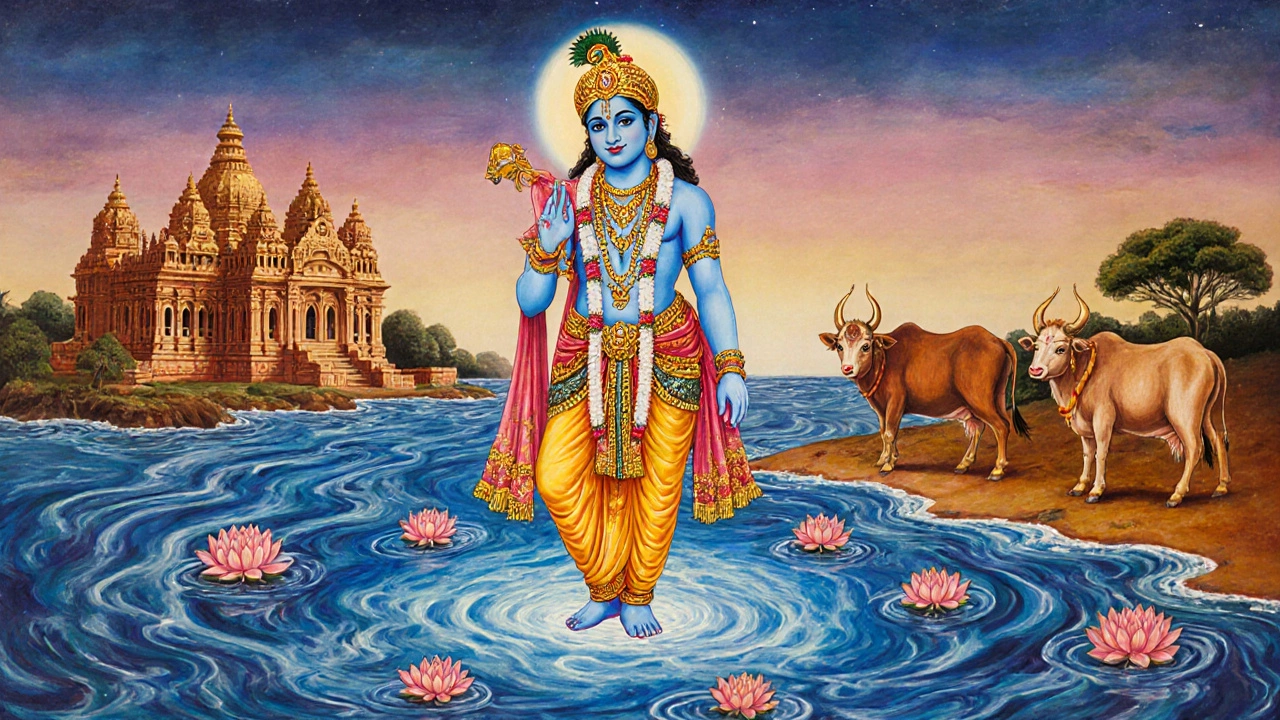
Hindu deities blue skin: Why gods like Krishna and Shiva are depicted with blue tones
When you see Hindu deities blue skin, a symbolic representation in Hindu iconography where gods like Krishna and Shiva are shown with blue or dark-toned skin. Also known as divine blue, it doesn’t mean these gods were literally blue—it’s a visual language pointing to something far deeper: infinity, the cosmos, and the unseen force behind all life. This isn’t just art style. It’s theology painted on temple walls, carved into statues, and whispered in chants across villages and cities.
The most common example is Krishna, the playful, divine cowherd and central figure in the Bhagavad Gita. His skin is often shown as deep blue, linking him to the vastness of the sky and the ocean. In the same way, Shiva, the destroyer and transformer, is called Neelakantha—blue-throated—after swallowing poison to save the universe. His throat turned blue, not his whole body, but artists extended the symbolism. Blue here isn’t decorative. It’s a reminder that these beings hold power beyond human limits—beyond color, beyond form, beyond death.
Other deities like Vishnu and Rama are also shown with blue skin, tying them to the same cosmic source. This isn’t random. In Hindu cosmology, blue represents the infinite, the unchanging, the all-pervading. It’s the color of the primordial ocean from which creation emerged. It’s the night sky holding stars. It’s the depth of consciousness itself. When you see a blue-skinned god, you’re not seeing a person—you’re seeing a force that holds the universe together.
There’s no single reason why blue was chosen. It’s a mix of ancient symbolism, poetic metaphor, and artistic tradition. Early artists didn’t have modern pigments. Dark blues and greens from minerals like lapis lazuli and malachite were rare and precious—used only for the most sacred figures. Over time, that rarity became sacredness. The color stuck because it worked. It made the divine feel different—bigger, quieter, older than the world.
And it’s not just about appearance. In temples, blue-skinned deities are often dressed in bright red or gold, creating a contrast that pulls your eye and your mind. The blue grounds the image. The colors around it pull you into story, ritual, devotion. You don’t just look at Krishna—you feel his presence.
Some people ask if this has anything to do with race or skin tone in real life. It doesn’t. Hinduism doesn’t tie divinity to human skin color. The blue is spiritual shorthand. It’s like using a red light to mean stop, or a white flag to mean surrender. It’s a symbol that works across languages, across centuries.
What you’ll find in the posts below isn’t just a list of blue gods. You’ll see how this symbol shows up in rituals, folk art, music, and even modern Tamil festivals. You’ll learn why a blue necklace might be worn during Diwali, how temple painters choose their pigments, and why some communities still avoid painting deities in blue today. This isn’t just about color. It’s about how a single visual choice carries thousands of years of meaning—and still speaks to people today.