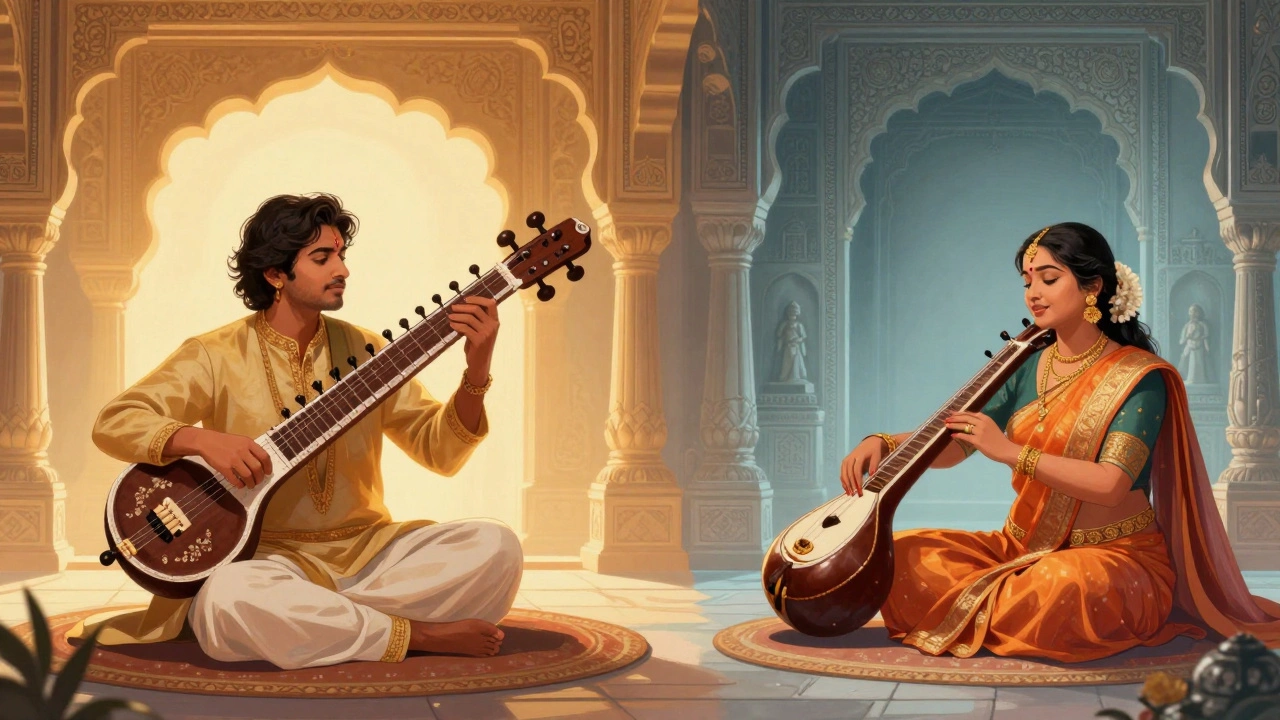
Hindustani vs. Carnatic Music Quiz
1. Which tradition is known for its emphasis on improvisation and emotional nuance?
2. What is the primary percussion instrument used in Carnatic music?
3. In which tradition is the violin played horizontally, resting on the knee?
4. Which term refers to a complex song composed by masters like Tyagaraja in Carnatic music?
5. A performance that begins with an Alap (slow, unmetered exploration) is characteristic of which style?
Your Score: 0/5
Quick Reference Guide
| Feature | Hindustani | Carnatic |
|---|---|---|
| Primary Focus | Improvisation & Emotion | Composition & Structure |
| Main Percussion | Tabla | Mridangam |
| Vocal Style | Khyal, Thumri | Kriti, Varnam |
| Key Instrument | Sitar, Sarod | Veena, Violin |
Have you ever sat in a concert hall, listening to the haunting strains of a violin or the rhythmic pulse of drums, and wondered why one performance feels like a spontaneous conversation while another feels like a meticulously crafted mathematical proof? If you are new to Indian classical music, this confusion is completely normal. The two major pillars of this tradition-Hindustani music and Carnatic music-share ancient roots but have evolved into distinct artistic languages with different rules, instruments, and philosophies.
While both traditions use ragas (melodic frameworks) and talas (rhythmic cycles), they approach them differently. Hindustani music, dominant in North India, embraces improvisation and emotional nuance, often influenced by Persian and Central Asian cultures. Carnatic music, thriving in South India, prioritizes compositional structure, lyrical precision, and theoretical purity. Understanding these differences helps you appreciate not just the notes, but the cultural stories behind them.
Before we dive into the technicalities, it is worth noting that music transcends borders. Just as travelers explore diverse cultures, some seek unique experiences in places like Bangkok. For those interested in exploring the vibrant social scene there, resources like this directory offer insights into local connections, though our focus remains firmly on the auditory landscapes of India today.
The Historical Divide: How Geography Shaped Sound
To understand the difference, you first need to look at history. Around the 13th century, Islamic invasions and the subsequent Mughal Empire brought significant Persian and Arabic influences to Northern India. This fusion gave birth to Hindustani music. It absorbed elements like the sitar, tabla, and khayal style, creating a sound that was more flexible and open to change.
In contrast, Southern India remained largely untouched by these political shifts. Carnatic music preserved older Vedic traditions and Sanskrit liturgical styles. It became a system where preserving the exact composition passed down from guru to disciple was paramount. While Hindustani musicians might feel free to alter a melody to suit the mood of the moment, a Carnatic musician views deviation from the original composition as a loss of integrity.
This historical split created two parallel universes. In the North, the court culture favored entertainment and emotional expression. In the South, temple culture favored devotion and structural complexity. Today, this means a Hindustani concert might feel like an intimate jazz session, whereas a Carnatic concert resembles a rigorous academic lecture delivered through song.
Raga: Improvisation vs. Composition
The concept of raga is central to both systems, but its application differs wildly. A raga is essentially a melodic scale with specific rules for ascent and descent, along with characteristic phrases that evoke a particular emotion or time of day.
In Hindustani music, the raga is the star. A performance often begins with an Alap-a slow, unmetered exploration of the raga’s notes without rhythm. The musician stretches each note, bending it slightly to create microtonal shades called meend. The goal is to immerse the listener in the atmosphere of the raga. Improvisation is key; no two performances of the same raga will be identical. The musician builds upon a basic theme, adding layers of complexity spontaneously.
Carnatic music treats the raga as a vehicle for composition. While there is improvisation, it is strictly bound by the lyrics and the composer’s intent. The core of a Carnatic performance is the Kriti, a complex song composed by masters like Tyagaraja, Muthuswami Dikshitar, or Syama Sastri. The musician must render the Kriti exactly as written, including intricate ornamentations. Improvisation happens within fixed sections like Niraval (repeating a line with variations) or Swarakkal (improvising on syllables), but always returning to the structured composition.
Think of it this way: Hindustani music is like painting on a blank canvas where the artist decides the image as they go. Carnatic music is like restoring a masterpiece, where the artist enhances the existing work without altering its fundamental design.
Tala: Rhythmic Cycles and Instruments
Rhythm, or tala, also shows a clear divide. Both systems use cyclical rhythms, but the complexity and instrumentation differ.
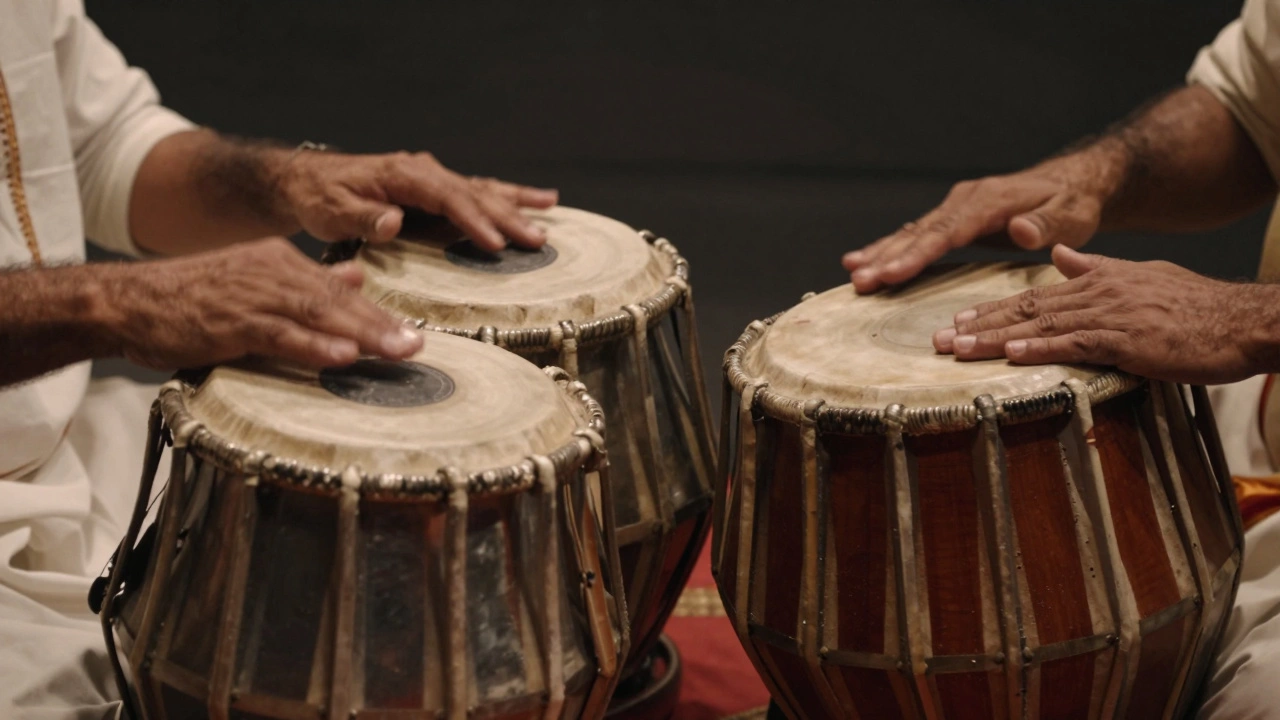
Hindustani music uses the Tabla as its primary percussion instrument. The Tabla consists of two drums-the larger Bayan (bass) and the smaller Dayan (treble). The playing style emphasizes bols (mnemonic syllables) and allows for extensive rhythmic improvisation. The Tala cycles in Hindustani music are often longer and more flexible, such as Teental (16 beats) or Jhaptaal (10 beats). The drummer and musician engage in a call-and-response battle called Jugalbandi, pushing each other to greater speeds and complexities.
Carnatic music relies on the Mridangam, a barrel-shaped drum played with palms and fingers. The Mridangam produces a richer, resonant tone compared to the crisp click of the Tabla. The rhythmic cycles, known as Talas, are based on a mathematical framework of Aksharas (time units). Common talas include Adi Tala (8 beats) and Rupaka Tala (6 beats). The interplay between vocalist and percussionist is precise, often involving Solkattus-percussive vocalizations that mimic drum patterns.
Another key difference lies in accompaniment. Hindustani vocals are typically accompanied by the Tanpura (drone) and sometimes Harmonium or Santoor. Carnatic vocals include the Tanpura, but also feature the Violin and Mridangam prominently during the main performance, creating a denser harmonic texture.
| Feature | Hindustani Music (North) | Carnatic Music (South) |
|---|---|---|
| Primary Focus | Improvisation & Emotion | Composition & Structure |
| Main Instrument | Sitar, Sarod, Tabla | Veena, Violin, Mridangam |
| Vocal Style | Khyal, Thumri | Kriti, Varnam |
| Raga Approach | Exploratory, fluid | Fixed, composition-bound |
| Language | Hindi, Urdu, Braj Bhasha | Sanskrit, Tamil, Telugu, Kannada |
| Concert Format | Gat, Jor, Jhala | Pallavi, Anupallavi, Charanam |
Instrumentation: The Tools of Tradition
The instruments themselves tell the story of their evolution. In Hindustani music, you will find string instruments like the Sitar, Sarod, and Bansuri (flute). These instruments allow for smooth gliding between notes, which is essential for expressing the meend and gamak (ornaments) typical of Northern style. The Sitar, with its sympathetic strings, creates a shimmering resonance that defines the Hindustani soundscape.
Carnatic music favors instruments that can articulate rapid passages and complex compositions clearly. The Saraswati Veena is the traditional string instrument, known for its clarity and sustain. Interestingly, the Violin was adapted into Carnatic music in the 19th century and is now played horizontally, resting on the knee, allowing the player to use fingering techniques similar to vocalists. This adaptation highlights the Carnatic emphasis on mimicking the human voice precisely.
Percussion also reflects these differences. The Tabla’s versatility suits the dynamic tempo changes of Hindustani performances. The Mridangam’s tonal range complements the structured rhythmic patterns of Carnatic talas. Even the drone instrument, Tanpura, is tuned differently: Hindustani Tanpuras often tune to Sa-Pa-Sa-Sa, while Carnatic Tanpuras may use Pa-Dha-Pa-Sa depending on the raga.
Performance Structure: What to Expect
If you attend a live concert, the structure will guide your experience. A typical Hindustani vocal concert starts with Khayal, focusing on raga elaboration. It may move to Thumri or Dadra, lighter forms with romantic themes. Instrumental concerts follow a suite format: Alap (slow intro), Jor (rhythmic pulse added), Gat (composition with rhythm), and Jhala (fast climax).
A Carnatic concert follows a strict sequence. It begins with a Varnam, a short piece that warms up the voice and demonstrates technical skill. Next comes the Pallavi, a complex composition chosen by the audience or musician, followed by several Kritis. The concert ends with a Tillana, a fast-paced rhythmic piece. This structure ensures a balanced progression from simple to complex, giving the audience a predictable yet engaging journey.
One thing to note is the role of the audience. In Hindustani music, listeners often clap or shout “Waah!” to show appreciation during impressive improvisations. In Carnatic music, applause is reserved for the end of pieces, maintaining a solemn atmosphere conducive to deep concentration.
Why Does This Difference Matter?
Understanding these distinctions enriches your listening experience. When you hear a Hindustani performance, listen for the spontaneity and emotional depth. Notice how the musician bends notes and explores silence. When you hear Carnatic music, pay attention to the lyrical beauty and rhythmic precision. Appreciate the mastery required to execute complex compositions flawlessly.
Both traditions are living arts, constantly evolving while honoring their past. Hindustani music invites you to feel; Carnatic music invites you to think. By recognizing their unique characteristics, you gain a deeper respect for the diversity of Indian culture. Whether you prefer the fluid freedom of the North or the structured elegance of the South, there is a place for you in the world of Indian classical music.
Can I learn both Hindustani and Carnatic music?
Yes, many musicians study both traditions. However, due to differences in technique and theory, it is recommended to master one before starting the other. Cross-training can enhance overall musicality but requires dedicated practice to avoid confusion.
Which tradition is older?
Both trace their roots to ancient Vedic chants. However, Carnatic music preserves older compositional forms and Sanskrit texts, making it appear more historically continuous. Hindustani music emerged later as a distinct style after medieval cultural exchanges.
What is the main instrument in Carnatic music?
The Saraswati Veena is the traditional primary instrument, though the Violin has become equally popular. Percussion is dominated by the Mridangam.
Is Hindustani music only instrumental?
No, Hindustani music includes rich vocal traditions like Khyal and Thumri. Vocal music is highly respected and forms the basis for instrumental styles.
How do I start learning Indian classical music?
Find a qualified guru who specializes in either Hindustani or Carnatic music. Start with basic scales (Sarali Varisai in Carnatic or Sarangi in Hindustani) and focus on developing pitch accuracy and rhythm sense.