When you think of ancient India, you might picture pyramids or temples-but the art of this civilization wasn’t built for show. It was built for meaning. Every carving, every brushstroke, every molded figure carried a story, a prayer, or a cosmic truth. Ancient Indian art didn’t just decorate; it connected people to the divine, to nature, and to each other.
The Roots: Indus Valley Civilization (3300-1300 BCE)
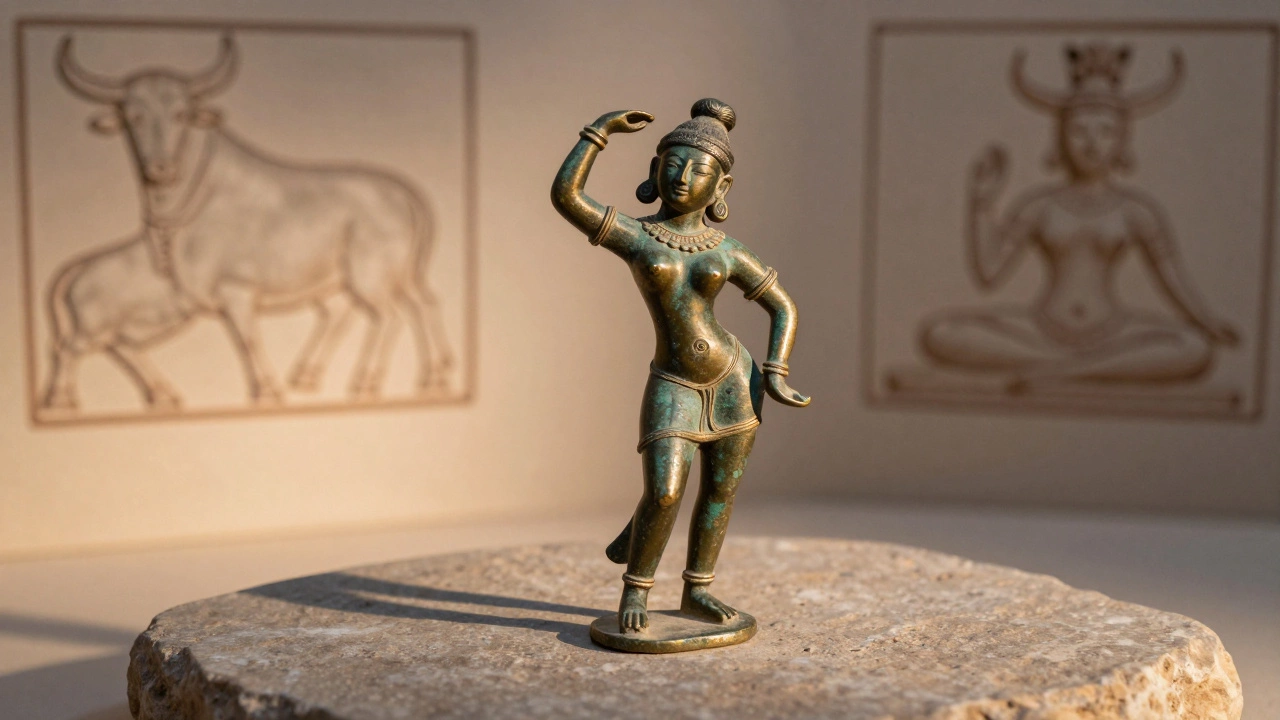
Long before the Vedas or the Mauryas, the Indus Valley Civilization was creating some of the earliest known art in South Asia. Cities like Mohenjo-Daro and Harappa had planned streets, drainage systems, and small but powerful artworks. The most famous piece? The bronze Dancing Girl. Standing just 10.8 centimeters tall, she wears a bangle-heavy arm and a confident pose. Her posture suggests movement, rhythm, maybe even ritual. No name, no title-just presence.
Seals made of steatite were equally important. They featured animals like bulls, unicorns (likely humped cattle), and elephants, each carved with astonishing detail. These weren’t just decorations. They were likely used for trade, identity, or religious marking. One seal shows a figure seated in a yogic pose, surrounded by animals. Scholars believe this could be an early depiction of Shiva as Pashupati, the Lord of Beasts. That’s over 4,000 years ago-already linking art with spirituality.
Sculpture and Stone: The Rise of Religious Imagery
After the Indus Valley declined, art didn’t disappear. It transformed. By the 6th century BCE, as Buddhism and Jainism spread, sculptors began shaping stone and bronze to represent spiritual ideals. The Mauryan period (322-185 BCE) gave us the iconic Ashoka Pillars. The most famous one, at Sarnath, holds four lions standing back-to-back. Their manes ripple with precision. Below them, a wheel-Dharma Chakra-symbolizes law, order, and the Buddha’s teachings. This pillar didn’t just mark territory; it announced a new moral order.
Then came the Mathura and Gandhara schools of sculpture. Mathura, in northern India, used red sandstone to create robust, earthy Buddha figures with broad shoulders and serene faces. Gandhara, influenced by Greek traders after Alexander’s campaigns, blended Hellenistic realism with Indian spirituality. Their Buddhas wore flowing robes like Roman togas, with wavy hair and defined facial features. This fusion didn’t dilute the message-it made it universal.
Painting That Lasted Millennia: The Ajanta Caves
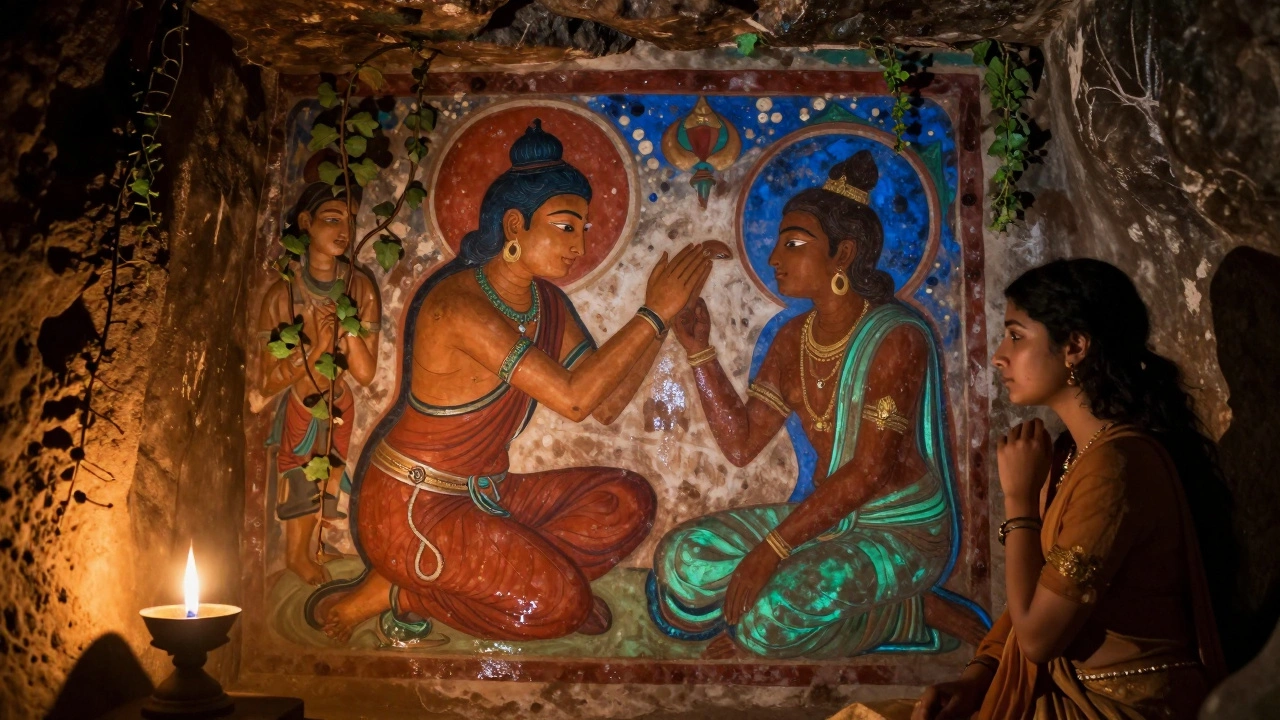
While sculpture spoke in stone, painting whispered in color. The Ajanta Caves in Maharashtra are among the most breathtaking examples. Carved into a cliff face between the 2nd century BCE and 6th century CE, these 30 rock-cut chambers hold murals so vivid they still glow.
These weren’t random scenes. They told stories from the Jataka tales-birth stories of the Buddha before he became enlightened. One painting shows a prince giving away his eyes to a beggar. Another shows a royal procession with elephants, musicians, and women in intricate jewelry. The artists used natural pigments: red from ochre, blue from lapis lazuli, green from malachite. They painted wet plaster, a technique called fresco secco, which helped the colors bond to the rock. Some figures have shading, depth, even emotion. A woman glancing over her shoulder isn’t just posing-she’s thinking.
These paintings survived because they were hidden. For centuries, the caves were buried under jungle. When British soldiers rediscovered them in 1819, they found a world frozen in time.
Temple Art: Where Architecture Became Worship
By the 5th century CE, temples became the canvas for India’s most ambitious art. The Khajuraho temples in Madhya Pradesh are famous for their erotic sculptures-but that’s only a fraction of the story. Out of 85 temples built between 950 and 1050 CE, only 25 remain. And yes, some show couples in intimate poses. But many more show dancers, musicians, warriors, and gods in daily life. These weren’t meant to shock. They were meant to reflect the Hindu belief that all aspects of life-love, labor, devotion-are sacred.
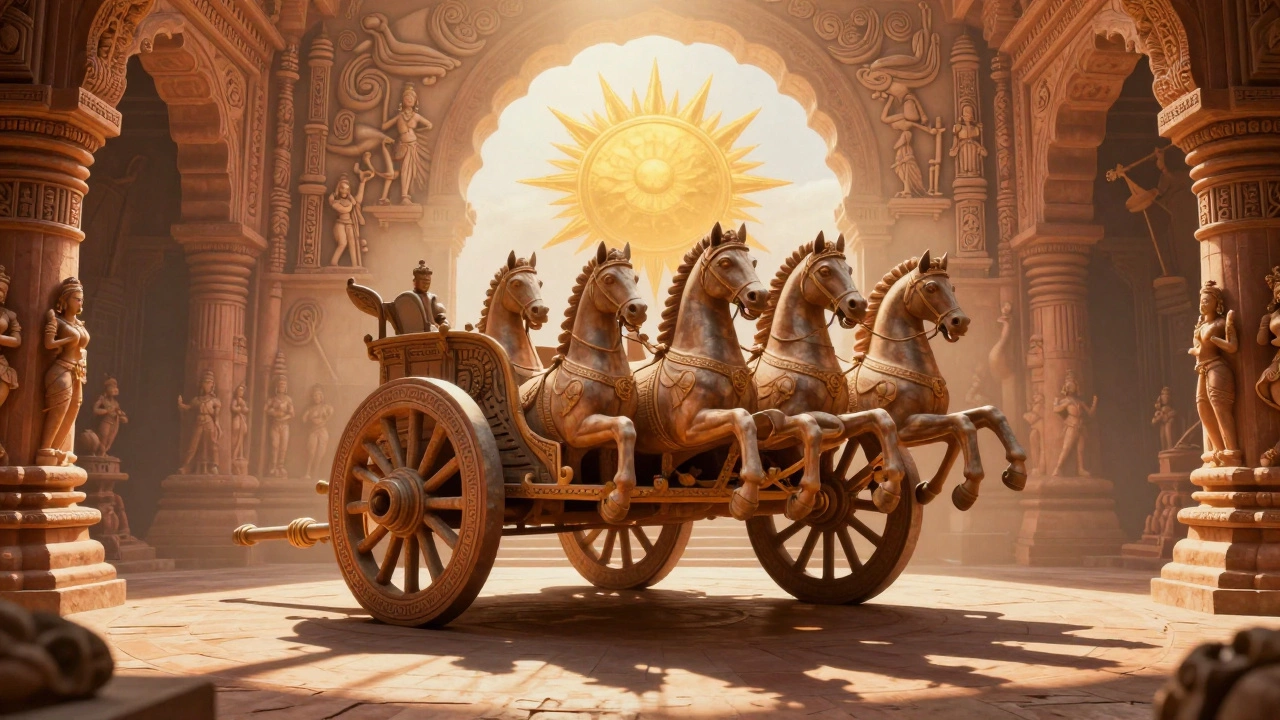
The Meenakshi Temple in Madurai and the Konark Sun Temple in Odisha took this further. Konark’s entire structure is shaped like a giant chariot with 12 wheels, pulled by seven horses. Each wheel is a sundial, accurate to the minute. The walls are covered in carvings of dancers, animals, and celestial beings. This wasn’t just decoration-it was a cosmic map carved in stone.
Symbolism Over Realism: The Language of Ancient Indian Art
Ancient Indian artists didn’t aim for photorealism. They aimed for essence. A lotus meant purity. A conch shell meant creation. A third eye meant wisdom. A raised hand in abhaya mudra meant fearlessness. These symbols weren’t optional-they were the language.
Even in sculpture, proportions followed sacred geometry. The Shilpa Shastras, ancient texts on art and architecture, laid out exact measurements. A god’s face should be one-fourth the height of the body. His eyes should be half the width of his nose. These rules weren’t rigid-they were spiritual. Art was a form of yoga: disciplined, intentional, meditative.
Compare this to Greek art, which celebrated the perfect human form. Indian art celebrated the perfect divine form. The body was a vessel. The soul was the point.
Legacy: How Ancient Art Still Shapes India Today
You don’t need to visit a museum to see ancient Indian art alive. Look at a Bharatanatyam dancer. Her hand gestures-hasta mudras-are straight from temple carvings. Look at a Kolam pattern drawn at a doorstep in Tamil Nadu. It echoes the geometric designs of Indus seals. Look at a Raja Ravi Varma painting from the 1800s. He didn’t invent the style-he revived it, using ancient iconography to tell epic stories to a new generation.
Even modern Indian cinema borrows from it. The costumes, the jewelry, the way a hero stands-these are all rooted in centuries-old visual codes. The art didn’t die. It evolved.
Why This Matters Now
When we reduce ancient Indian art to “exotic carvings” or “old statues,” we miss the point. This wasn’t decorative craft. It was philosophy made visible. It was science wrapped in beauty. It was a way of seeing the world that didn’t separate the sacred from the everyday.
Today, as digital screens flood our lives with noise, ancient Indian art offers a quiet counterpoint: slow, intentional, meaningful. It reminds us that art doesn’t have to be loud to be powerful. Sometimes, all it needs is a single line, a single color, a single gesture to speak for centuries.
What are the main types of ancient Indian art?
The main types include sculpture (stone and bronze), cave paintings (like Ajanta), temple carvings (Khajuraho, Konark), Indus Valley seals, and metalwork (like the Dancing Girl). Each served religious, cultural, or daily life purposes and followed strict symbolic rules.
Did ancient Indians paint on walls?
Yes. The Ajanta Caves contain some of the finest surviving wall paintings from ancient India, dating from 2nd century BCE to 6th century CE. Artists used natural pigments on wet plaster, creating lifelike figures with shading and emotion. These murals depicted Buddhist Jataka tales and royal life.
Why are there erotic sculptures in ancient Indian temples?
The erotic carvings at places like Khajuraho aren’t pornographic-they’re symbolic. In Hindu philosophy, sexuality is part of dharma (duty) and kama (desire), one of life’s four goals. These sculptures represent fertility, cosmic balance, and the sacredness of the human body. They’re placed near temple entrances to remind visitors that spiritual and physical life are interconnected.
How did Greek influence show up in Indian art?
After Alexander’s invasion in 326 BCE, Greek artists settled in Gandhara (modern-day Pakistan and Afghanistan). They brought realistic anatomy, drapery folds, and facial detail. This shaped the Gandhara style of Buddha statues, which look more like Hellenistic gods than Indian yogis. But the spiritual meaning stayed Indian-blending cultures without losing depth.
Is ancient Indian art still used today?
Absolutely. Indian classical dance uses mudras from temple carvings. Traditional rangoli and kolam patterns mirror Indus seal designs. Even Bollywood costumes and jewelry draw from ancient motifs. The symbols, proportions, and spiritual intent of ancient art continue to guide modern Indian aesthetics.
If you want to understand India’s soul, don’t just read its texts. Look at its art. Every line, every curve, every carved face holds a piece of a civilization that saw the divine in everything-even a dancer’s smile, or a seal’s silent bull.