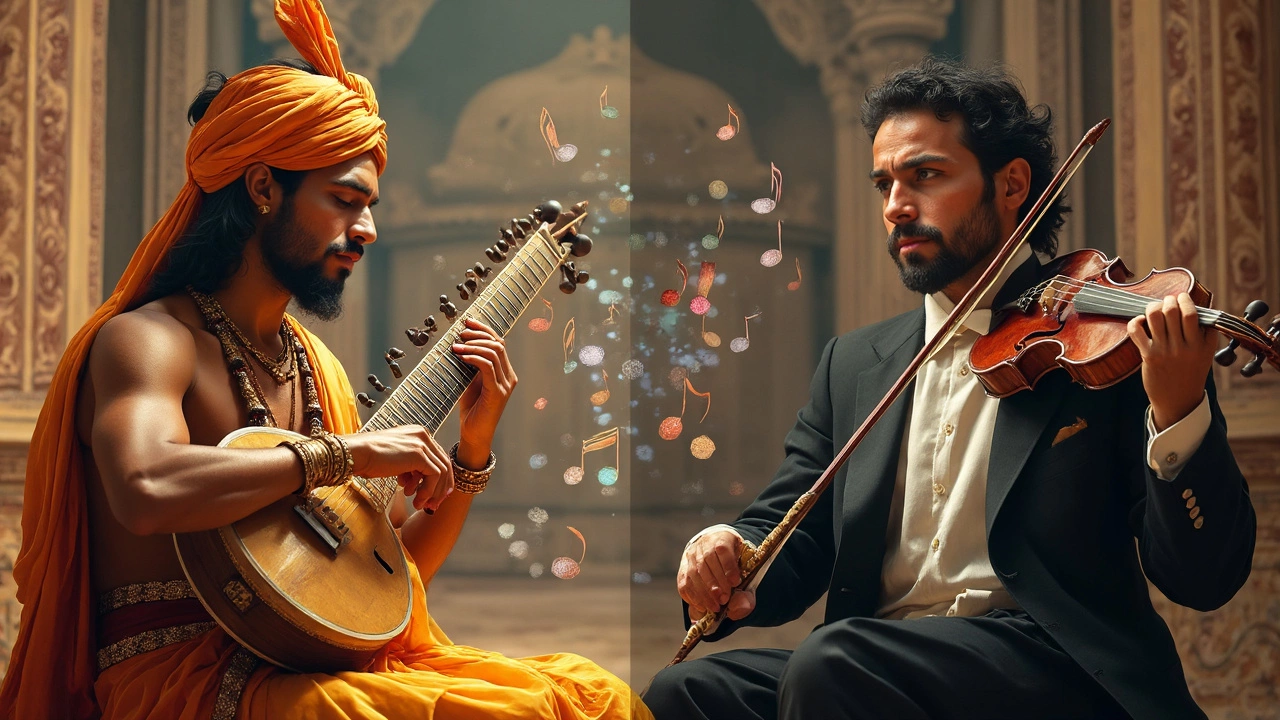
Western Music and Its Connection to Tamil and Indian Cultural Sounds
When you think of Western music, a broad category of musical traditions rooted in Europe and North America, characterized by harmonic structures, sheet music notation, and instruments like the piano and guitar. It's often seen as the global default—played in malls, movies, and phones worldwide. But how does it actually relate to the rhythms of Tamil Nadu, the ragas of Carnatic music, or the devotional chants of South Indian temples? The answer isn’t about which is better. It’s about how they’re built differently—and why that matters.
Western music leans on harmony: multiple notes played together to create chords. Think of a pop song where the guitar, bass, and drums lock into a steady beat. Indian classical music, whether Carnatic music, a highly structured, devotional system from South India that uses ragas (melodic frameworks) and talas (rhythmic cycles) to express emotion or Hindustani music, the North Indian tradition shaped by Persian influences, with improvisation at its core, works the opposite way. It’s all about a single melody line, stretched and shaped over time. One singer, one instrument, and a lot of space. No backing band. No chord progressions. Just pure, evolving sound. That’s why a Carnatic violinist doesn’t play chords—they play the same note in 17 different ways, depending on mood and time of day.
There’s a myth that Western music is more advanced because of its technology or complexity. But that’s like saying a smartphone is smarter than a handwritten letter. They serve different purposes. Western music thrives on repetition and mass appeal—think of a catchy chorus you can hum after one listen. Indian music rewards patience. It’s meant to be listened to deeply, sometimes for hours, to feel the subtle shifts in tone and emotion. That’s why you won’t find a Carnatic piece on a TikTok trend. But you’ll find it in a temple courtyard at sunrise, where the notes are meant to lift the soul, not just fill the air.
And yet, the two worlds aren’t completely separate. Modern Indian composers blend Western orchestration into film scores. Tamil pop songs use drum machines and synths. Even the famous "White Christmas", the highest-earning song in history, shows how a simple melody can cross borders—just like how Tamil folk songs like "Bol Banao" carry deep meaning through rhythm alone, even without words. The real question isn’t whether Western music belongs in Tamil culture. It’s whether we’re listening closely enough to hear what each tradition teaches the other.
Below, you’ll find articles that dig into these contrasts—not to pick sides, but to show how music tells us who we are. From why Indian gods are painted blue to how the Catholic Church views yoga, these stories reveal how sound, belief, and culture are woven together. You’ll see how a Tamil family might celebrate Diwali with a mix of traditional drums and a Western pop playlist. You’ll learn why a Punjabi bhangra beat can feel familiar to a hip-hop fan. And you’ll understand why a nonsense song in rural Tamil Nadu might be more powerful than any chart-topping hit.