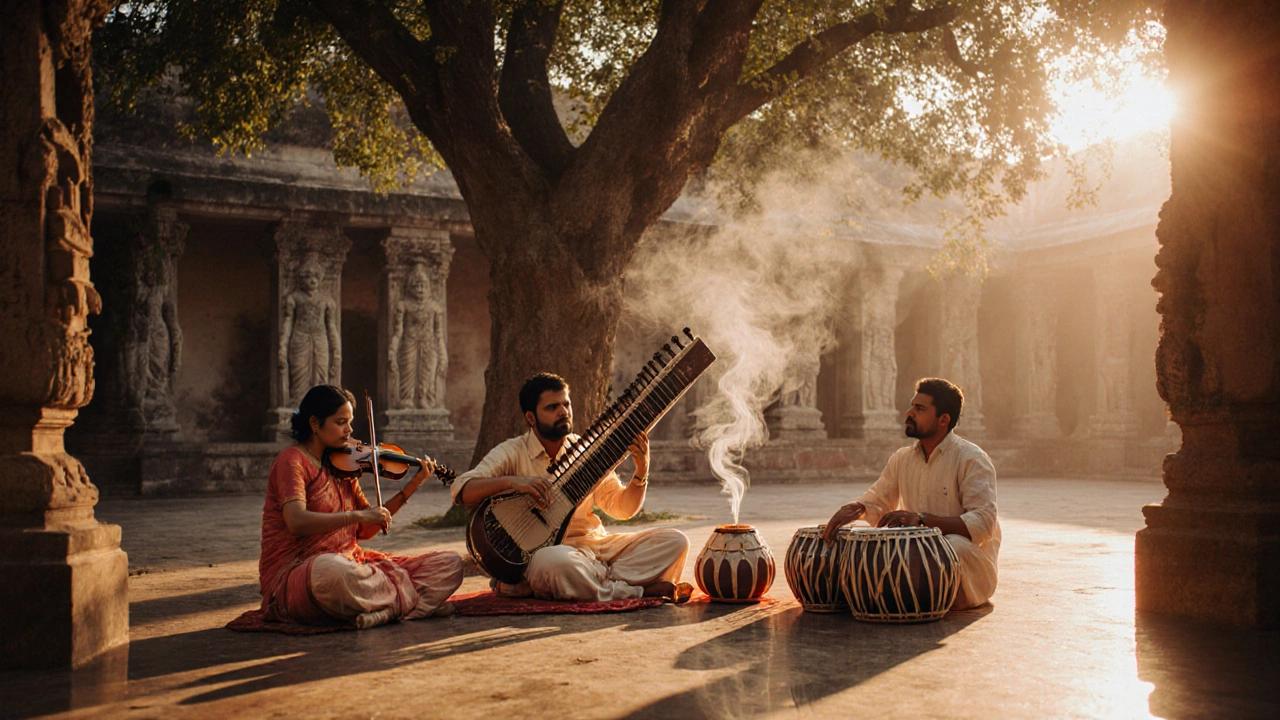
South Indian Music: Roots, Instruments, and Voices That Define a Region
When you hear South Indian music, a rich, ancient system of melodic and rhythmic structures rooted in the Dravidian south of India, often called Carnatic music. Also known as Carnatic music, it’s not background noise—it’s a spiritual practice, a family tradition, and a daily rhythm for millions. Unlike the more widely known North Indian style, South Indian music stays deeply tied to temple rituals, family lineages, and oral teaching. It doesn’t chase trends. It holds space for patience, precision, and devotion.
This music relies on a few core tools: the veena, a plucked string instrument with a deep, resonant voice, central to classical performances in Tamil Nadu and Andhra Pradesh, the mridangam, a double-headed drum that drives the rhythm with astonishing complexity, and the human voice—often the most powerful instrument of all. You’ll hear it in temple chants, in wedding processions, in children learning swaras before they learn their ABCs. It’s not performed for applause. It’s performed to connect—to gods, to ancestors, to the ground beneath your feet.
And while Carnatic music gets the spotlight, the real heartbeat of South Indian music lives in its folk traditions. Think of Tamil folk music, the raw, rhythmic songs sung during harvests, festivals, and village rituals, often using simple instruments like the thavil or urumi. These aren’t polished studio tracks. They’re voices passed down through generations, full of nonsense syllables like bol banao, call-and-response chants, and stories told through rhythm. You’ll find echoes of this in songs sung by women grinding grain, by fishermen waiting for the tide, by dancers in Karakattam or Theru Koothu.
What ties it all together? A shared understanding that music isn’t entertainment—it’s memory. It’s identity. It’s the sound of a culture that refused to be erased, even under colonial rule, even in the age of streaming. You won’t find South Indian music on TikTok trends. But you’ll find it in the quiet moments: a grandmother humming a raga while cooking, a boy practicing scales before dawn, a temple bell ringing between notes.
Below, you’ll find articles that dig into this world—how Tamil communities celebrate music during festivals, why certain instruments are sacred, how folk singing carries meaning beyond lyrics, and why the color blue on deities isn’t just art—it’s sound made visible. Whether you’re curious about the veena’s strings or the rhythm of a village drum, this collection shows you the real South Indian music—the kind that doesn’t need a stage to matter.