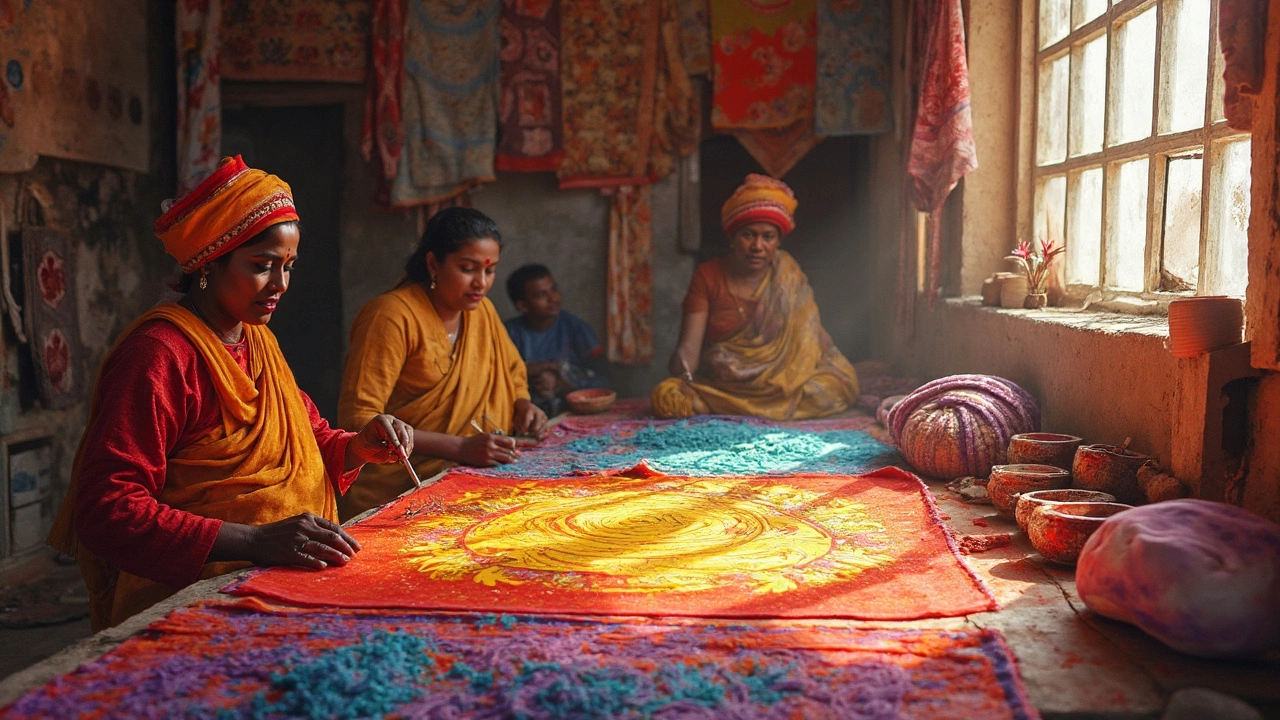
Rogan Art: The Traditional Painting Technique of Gujarat
When you think of Indian art, you might picture temple carvings or Mughal miniatures—but Rogan art, a centuries-old textile painting technique from Gujarat that uses castor oil and natural pigments to create dazzling, mirror-embellished designs. Also known as Roghan art, it’s one of the few living traditions where paint is applied with a metal stick, not a brush, onto cloth. This isn’t just decoration—it’s a ritual. The oil-based paint, heated and mixed with natural dyes, is stretched into fine, swirling lines that look like lace. Each piece takes days to complete, and the designs often draw from nature: peacocks, flowers, and mythical creatures, all rendered in bold reds, greens, and golds.
Rogan art is deeply tied to the Khatris, a community of artisans in the village of Nirona in Kutch, Gujarat, who have passed this skill down for over 400 years. The technique was once used to make ceremonial garments for weddings and religious events, especially for women in royal families. But today, fewer than 20 families still practice it. The oil paint dries slowly, the tools are handmade, and the process demands patience most modern makers don’t have. That’s why Rogan art is now listed as an endangered heritage by UNESCO. It’s not just about the pattern—it’s about the rhythm of the hand, the smell of heated oil, and the quiet focus of generations.
What makes Rogan art unique isn’t just its beauty—it’s how it connects to other Indian crafts. Like Kalamkari, the hand-blocked textile art from Andhra Pradesh that uses natural dyes and storytelling motifs. Or Tie-dye, the resist-dyeing technique found across India, from Gujarat to Tamil Nadu, where patterns emerge from folded and tied cloth. Rogan art stands apart because it’s painted, not printed, and the mirror work—tiny glass discs sewn into the design—is added later, like jewels. You won’t find this in mass-produced fabrics. Every piece is one-of-a-kind, signed by the artist’s hand, not a machine.
If you’ve ever seen a vibrant, shimmering shawl or a bedspread with endless swirls and tiny mirrors, you’ve seen Rogan art. But you won’t find it in big stores. It survives because of a handful of families who still believe in the craft. The posts below explore how this art form connects to broader traditions in Tamil Nadu and beyond—from the mirror work in Tamil folk dance costumes to the symbolic use of color in Indian gods’ paintings. You’ll also find stories of the artists keeping it alive, the challenges they face, and how you can support a tradition that’s fading faster than the oil dries.