Hindustani Classical Music: Origins, Instruments, and Its Place in Indian Culture
When you hear the slow, swelling notes of a Hindustani classical music, a North Indian system of melodic and rhythmic improvisation rooted in ancient Vedic chants and refined over centuries. Also known as North Indian classical music, it's not just performance—it's a spiritual discipline passed down through generations of gharanas, or musical lineages. Unlike its southern counterpart, Carnatic music, Hindustani music thrives on space, silence, and emotional depth. Each raga isn’t just a scale—it’s a mood, a time of day, even a season. A raga played at dawn feels different than the same raga at midnight, because the tradition believes sound shapes the atmosphere around us.
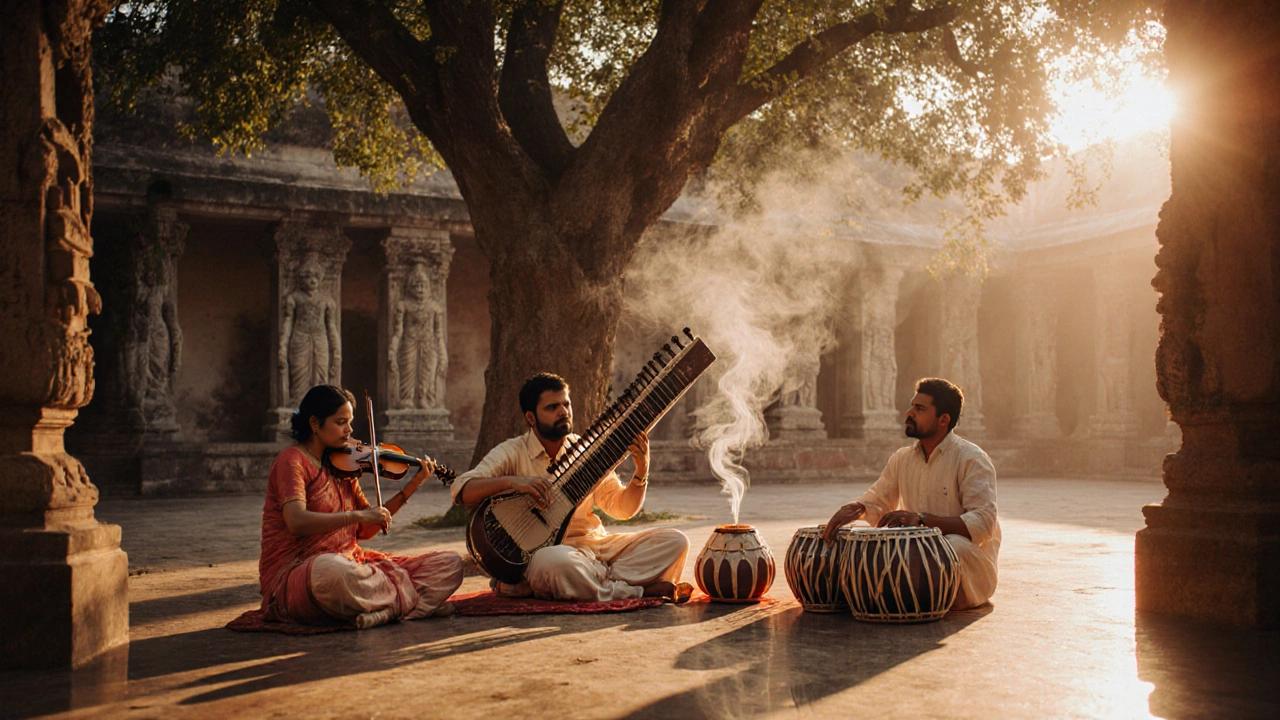
At its heart are two pillars: raga, a framework of notes with specific ascending and descending patterns, emotional rules, and ornamentation techniques and tala, the cyclical rhythmic structure that gives the music its pulse. These aren’t rigid formulas—they’re living templates. A master vocalist or instrumentalist bends them, stretches them, and sometimes breaks them, all while staying true to the essence. You’ll hear this in the slow alap of a sitar, where the musician explores each note like a whispered prayer, or in the fiery exchanges between a tabla player and a vocalist, where rhythm becomes a conversation. The sitar, a plucked string instrument with sympathetic strings that hum in resonance, and the tabla, a pair of hand-played drums with a wide range of tonal possibilities, aren’t just tools—they’re voices in this ancient dialogue. Even the human voice, in forms like khayal or dhrupad, is treated like an instrument, capable of microtones and emotional nuance unmatched by any machine.
This music doesn’t live in concert halls alone. It’s in the alleys of Varanasi, where a boy practices for hours before sunrise. It’s in the homes of Delhi, where families gather to listen to recordings of Ustad Bismillah Khan’s shehnai or Pandit Ravi Shankar’s sitar. It’s in the way a grandmother hums a raga while cooking, or how a young artist in Mumbai blends it with jazz and electronic beats. Hindustani classical music isn’t frozen in time—it’s breathing, adapting, and still teaching us how to listen deeper. What you’ll find in the posts below isn’t just history or theory—it’s real stories, real musicians, and real moments where this music changed lives. From the misunderstood roots of vocal techniques to the instruments you never knew were part of this world, each article brings you closer to understanding why this music still matters.