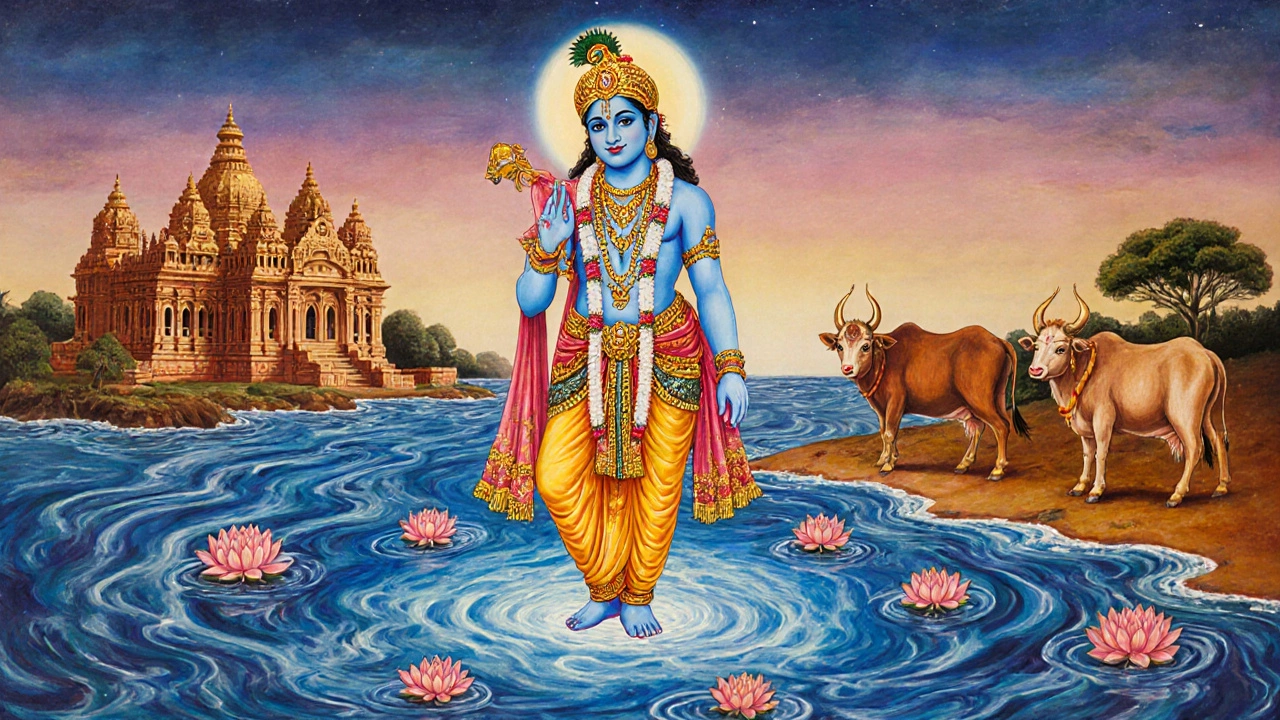
Blue Gods in Mythology: Who Are They and Why Do They Matter?
When you see a god with blue skin, it’s not a random color choice—it’s a symbol. In blue gods in mythology, divine figures depicted with blue skin represent the infinite, the cosmic, and the transcendent. Also known as dark-skinned deities, these figures aren’t meant to be literal; they’re visual metaphors for something beyond human understanding. Across cultures, blue has always been tied to the sky, the ocean, and the unseen. But in Indian traditions, it’s more than that—it’s the color of the boundless, the eternal, the all-pervading.
The most well-known blue gods, primarily found in Hinduism, include Vishnu, Krishna, and Shiva. Also known as dark-complexioned deities, they embody qualities that go beyond physical form—compassion, destruction of ego, and cosmic balance. Vishnu, the preserver, is often shown with blue skin because he holds the universe together, just as the sky holds the stars. Krishna, his avatar, wears blue not because of his skin tone, but because his presence fills the world with divine love. Even Shiva, the destroyer, is sometimes painted blue after swallowing poison to save creation—his blue throat, or Neelakantha, marks his sacrifice.
These aren’t just stories. People see blue gods in temples, in paintings, in festivals. They’re not decorative. They’re reminders. When you look at a blue-skinned deity, you’re not seeing a person—you’re seeing a concept: infinity, calm, power that doesn’t need to shout. This is why you’ll find blue gods in Tamil Nadu’s temple carvings, in Bengal’s pattachitra art, and even in modern digital illustrations. The color sticks because the meaning does.
And while Greek or Egyptian gods are usually shown with human skin tones, Indian mythology leans into the symbolic. There’s no need to explain why a god is blue—you just feel it. That’s the power of the image. It doesn’t ask for logic. It invites awe.
What you’ll find in the posts below isn’t just a list of blue gods. It’s a deeper look at how color, belief, and identity mix in mythology. You’ll see why people confuse Aphrodite with Lakshmi, how Hindu deities differ from global myths, and why some traditions paint their gods blue while others don’t. This isn’t about art history—it’s about what people have always needed: a way to see the invisible.