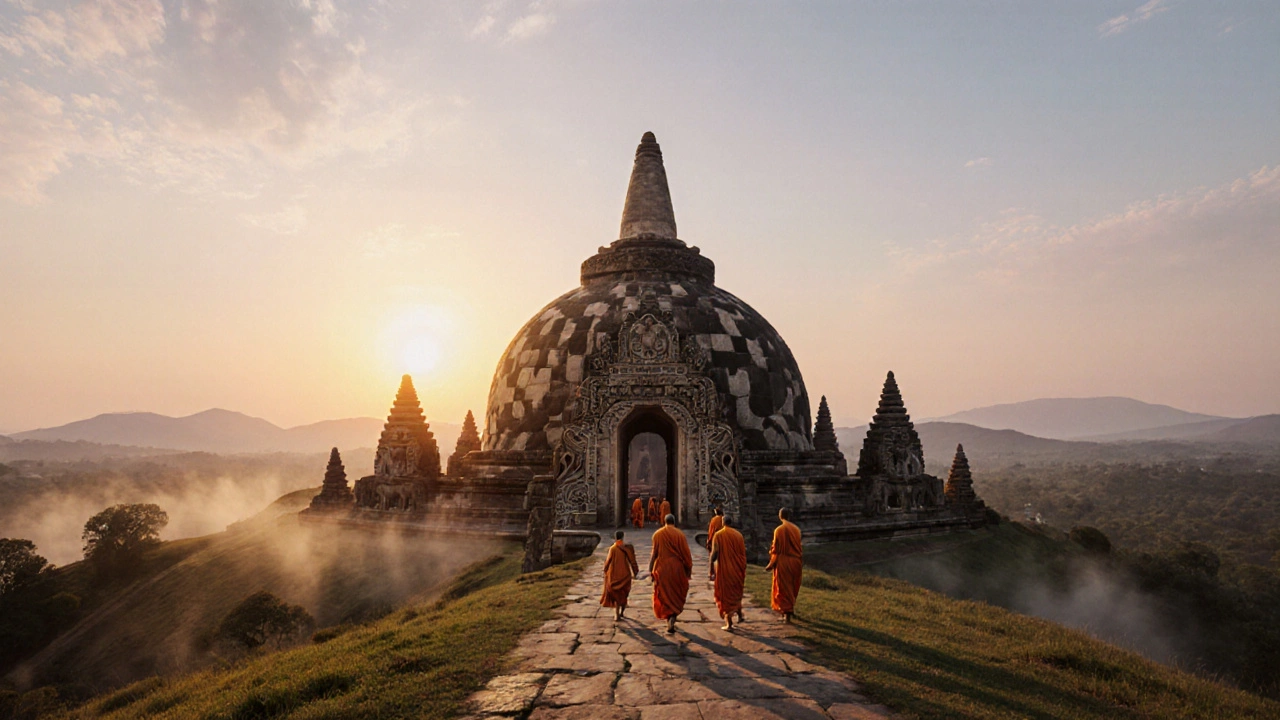
India's Oldest Landmark: Discover the Ancient Sanchi Stupa
Explore why Sanchi Stupa, commissioned by Ashoka around 250BCE, is regarded as India's oldest landmark, its history, architecture, visitor tips, and preservation.
When you think of an ancient Indian monument, a physical structure built centuries ago that reflects religious, political, or cultural values in Indian history. Also known as historical Indian heritage site, it often serves as a silent witness to empires, spiritual movements, and lost ways of life. These aren’t just ruins—they’re stories carved in stone, painted in frescoes, and whispered through wind-swept courtyards.
Many ancient Indian monument structures were built not just to impress, but to connect the earthly with the divine. Take the temple architecture of South India—towering gopurams covered in gods and demons, designed so sunlight hits the inner sanctum on specific days of the year. Or the Indus Valley civilization cities like Mohenjo-Daro, where grid-lined streets and advanced drainage systems prove urban planning was alive 4,500 years ago. These aren’t random piles of rock. Each one was engineered with purpose, aligned with stars, and built to last longer than the kings who ordered them.
Some of these sites are famous worldwide—Taj Mahal, Khajuraho, Hampi—but others hide in plain sight. A stone pillar in Madhya Pradesh, a stepped well in Gujarat, a rock-cut cave in Maharashtra—these are all ancient Indian monument examples that don’t make the postcards but hold just as much meaning. They tell us how people worshipped, how they traded, how they buried their dead, and even how they celebrated. And while the Taj Mahal draws millions, it’s the lesser-known sites—like the 1,000-year-old temples of Bhubaneswar—that still hold rituals performed exactly as they were a millennium ago.
What makes these monuments so powerful isn’t just their age. It’s how they survive. They’ve seen invasions, weather, neglect, and even modern development. Yet, they still stand. Why? Because communities kept them alive—not just as tourist spots, but as living parts of daily life. People still light lamps in the same corners, offer flowers where queens once did, and sing songs under the same arches. These aren’t dead relics. They’re active memory.
What you’ll find in the posts below isn’t just a list of old buildings. It’s a look at the people behind them—the sculptors who carved gods with tools no bigger than a pen, the engineers who moved tons of stone without machines, the priests who kept the rituals going through centuries of change. You’ll see how color symbolism in temple walls connects to today’s festivals, how music once played in temple courtyards still echoes in folk traditions, and why some monuments were abandoned while others became sacred again. No fluff. No guesswork. Just real stories from real places that still breathe.
Explore why Sanchi Stupa, commissioned by Ashoka around 250BCE, is regarded as India's oldest landmark, its history, architecture, visitor tips, and preservation.