Indian Heritage Discovery Tool
Explore the "living museum" of India. Select a category to discover a key element of Indian heritage and learn its significance.
Welcome Explorer!
Select a heritage element from the list to uncover its story.
Quick Highlights of India's Legacy
- Spiritual Roots: Birthplace of Hinduism, Buddhism, Jainism, and Sikhism.
- Architectural Wonders: A mix of Dravidian styles in the South and Indo-Islamic architecture in the North.
- Linguistic Diversity: Hundreds of languages and dialects, with Sanskrit acting as a classical foundation.
- Social Fabric: A complex system of joint families, community bonds, and a deep respect for elders.
The Bedrock of Belief: Spiritual and Philosophical Heritage
You cannot talk about India without talking about the soul. The foundation of the country's heritage lies in the Vedic Civilization, which introduced the Vedas, the oldest scriptures of Hinduism, thousands of years ago. These texts didn't just dictate religion; they explored astronomy, medicine, and the nature of existence.
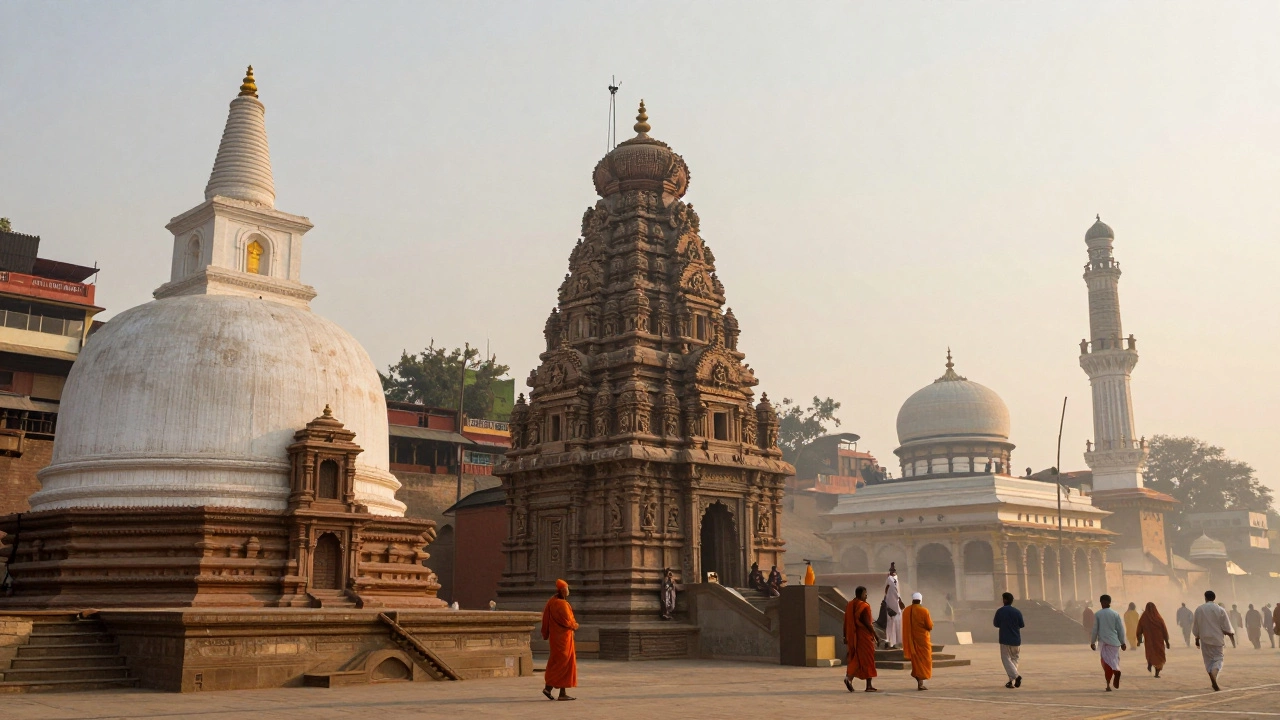
But India's spiritual heritage isn't just about old books. It is about the lived experience of concepts like Dharma (duty/righteousness) and Karma (action and consequence). Have you ever wondered why Indian society places such a high premium on patience and acceptance? It stems from this philosophical belief that life is a cycle of birth and rebirth. This worldview created a culture that is inherently pluralistic. It is why you'll find a Buddhist stupa, a Hindu temple, and a Mosque often sharing the same neighborhood in cities like Varanasi.
Beyond the mainstream, the heritage of Sufism and the Bhakti Movement brought a more personal, emotional approach to God. This shifted the focus from rigid rituals to a direct, loving connection with the divine, breaking down many social barriers and influencing the poetry and music we still see today.
The Visual Language: Art, Architecture, and Sculpture
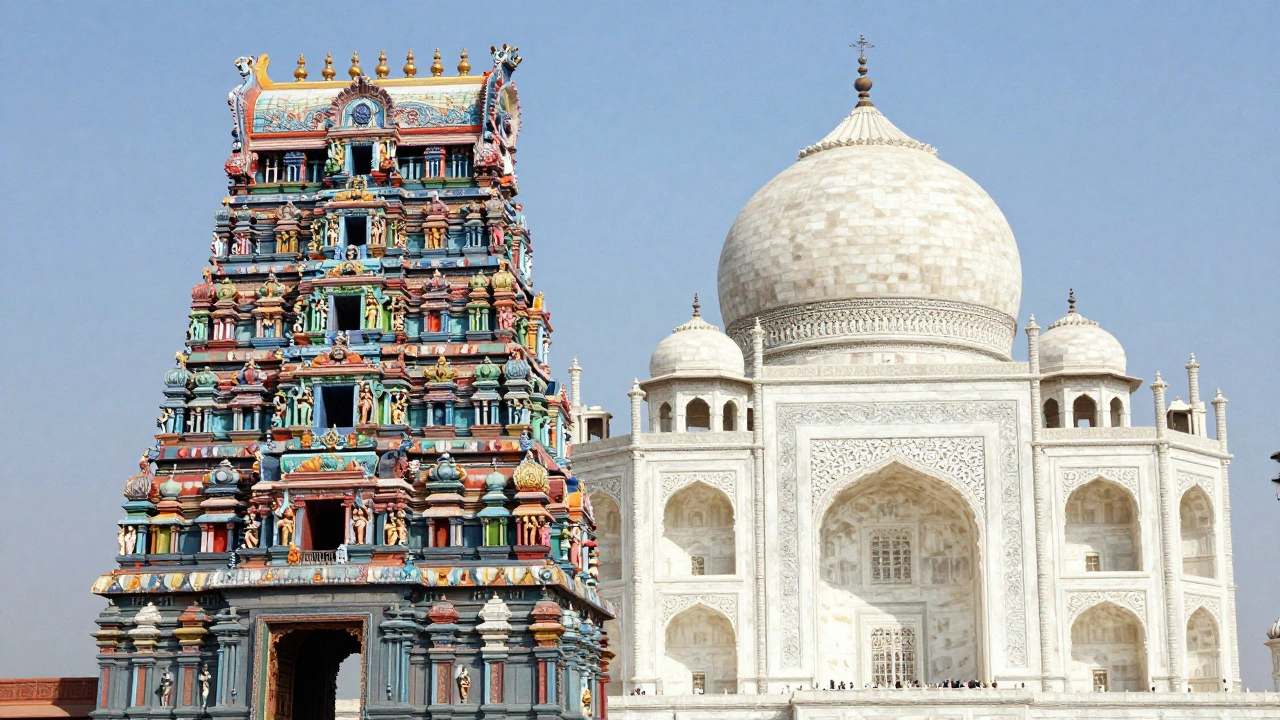
If you walk through the streets of India, the heritage is written on the walls. The architectural journey starts with the Indus Valley Civilization, where people were building planned cities with drainage systems 4,500 years ago. Fast forward a few millennia, and you see the contrast between the towering Gopurams (gateway towers) of South Indian temples and the delicate marble inlay of the Taj Mahal.
The Mughal Empire left an indelible mark by blending Persian elegance with Indian sensibilities. Think of the Red Fort or the Jama Masjid; these aren't just buildings, they are statements of power and aesthetic harmony. Meanwhile, the Dravidian style, seen in the Brihadisvara Temple, focuses on massive granite structures and intricate carvings of deities that tell epic stories of the Ramayana and Mahabharata.
| Style | Key Characteristics | Famous Example | Primary Influence |
|---|---|---|---|
| Dravidian | Pyramidal towers (Vimanas), massive gateways | Meenakshi Temple | Indigenous South Indian |
| Indo-Islamic | Domes, arches, minarets, calligraphy | Humayun's Tomb | Persian and Central Asian |
| Cave Architecture | Rock-cut monolithic structures | Ajanta and Ellora Caves | Buddhist and Jain monks |
And it's not all about big monuments. The heritage of painting is just as vivid. From the royal miniatures of Rajasthan to the tribal Warli art from Maharashtra, Indian art is about storytelling. Warli art, for example, uses simple circles, triangles, and squares to depict the daily life of villagers, proving that you don't need expensive paints to leave a lasting cultural mark.
The Rhythm of Life: Music and Dance
In India, music and dance are not just entertainment; they are forms of worship. The Indian Classical Music is split into two main schools: Hindustani (North) and Carnatic (South). While Hindustani music was heavily influenced by Persian sounds, Carnatic music remained more rooted in ancient temple traditions. Both rely on the concepts of Raga (melody) and Tala (rhythm), which are so complex that a single Raga can be played for hours, exploring every possible emotional nuance.
Then there is the dance. Bharatanatyam from Tamil Nadu is a perfect example of how heritage is preserved. It combines precise footwork with Mudras (hand gestures) that act as a visual language. A dancer can tell an entire story about a deity's love or a warrior's rage without saying a single word. Other forms like Kathak bring in the influence of the Mughal courts, focusing on fast spins and rhythmic footwork.
But don't forget the folk traditions. Whether it's the high-energy Bhangra from Punjab or the graceful Garba from Gujarat, these dances are the heartbeat of rural India. They celebrate the harvest, the monsoon, and the cycles of nature, keeping the community connected to its land and its ancestors.

The Living Tradition: Customs, Clothing, and Cuisine
Heritage isn't something you only find in a museum; you wear it and eat it. Take the Saree, for instance. This single piece of unstitched cloth is draped in dozens of different ways across the country, with each style signaling the wearer's region, caste, or community. The Banarasi silk from Varanasi and the Kanjeevaram from Tamil Nadu are not just garments; they are heirlooms passed from grandmother to granddaughter.
The food is perhaps the most accessible part of Indian heritage. Indian cuisine is a masterclass in the use of Ayurveda, the ancient system of medicine. The spices used in a curry aren't just for flavor; turmeric is for inflammation, cumin is for digestion, and ginger is for immunity. This functional approach to eating has been practiced for millennia.
Socially, the heritage of the joint family system has defined Indian life. While urban migration is changing this, the value placed on filial piety and collective responsibility remains strong. The tradition of Atithi Devo Bhava (The Guest is God) still permeates Indian households, where welcoming a stranger with tea and snacks is seen as a spiritual duty.
Challenges and the Modern Evolution
Is this heritage static? Far from it. India is currently navigating the tension between preservation and modernization. Many ancient sites struggle with pollution and overcrowding. For example, the yellow marble of the Taj Mahal has faced discoloration due to air pollution, leading to strict zoning laws around the monument.
There is also the challenge of "folk vs. classical." While classical arts get the funding, many regional folk songs and crafts are disappearing as the younger generation moves toward global pop culture. However, a new trend is emerging: the "Neo-Ethnic" movement. Young designers are bringing ancient weaves back into fashion, and musicians are blending classical sitar with electronic beats. This is how heritage survives-not by staying the same, but by evolving to remain relevant.
What is the difference between Indian culture and Indian heritage?
Culture is the living, breathing way people behave and interact today-their language, current beliefs, and social habits. Heritage is the legacy left behind by ancestors, which can be tangible (like the Pyramids of Giza or the Taj Mahal) or intangible (like the Vedas or traditional dance forms). Essentially, heritage is the foundation upon which the current culture is built.
Why is Indian culture considered so diverse?
India's diversity comes from its geography and history. Because it is a massive subcontinent, different regions developed unique linguistic and social norms. Additionally, India's coastlines made it a hub for trade and conquest, bringing influences from the Middle East, Central Asia, and Europe, all of which blended with indigenous traditions over thousands of years.
Which are the main religions that shaped Indian heritage?
Hinduism, Buddhism, Jainism, and Sikhism all originated in India. These faiths shaped the country's ethics, art, and law. Later, Islam and Christianity arrived and integrated into the landscape, adding layers of architectural brilliance and new philosophical perspectives, creating the pluralistic society India is today.
How does Ayurveda fit into Indian culture?
Ayurveda is one of the world's oldest holistic healing systems. It treats the body, mind, and spirit as connected. In Indian culture, it's not just a medical practice but a way of life, influencing everything from the types of food eaten during different seasons to the way homes are structured for maximum airflow and light.
Are Indian classical dances still relevant today?
Yes, very much so. While they started in temples and courts, dances like Bharatanatyam and Kathak are now taught globally. They have moved from being purely religious offerings to becoming respected performing arts that are showcased in international theaters, blending traditional storytelling with contemporary themes.
Ways to Experience the Heritage
If you are looking to connect with this legacy, start with the "Living Heritage" sites. Instead of just visiting a museum, visit a Haat (traditional market) to see artisans practicing pottery or weaving. Spend a day in a village during a festival like Holi or Diwali to see how community bonds are reinforced. Read the epics-the Ramayana and the Mahabharata-not as religious texts, but as sociological studies on human nature and conflict. By engaging with the people and the practices, you'll find that Indian heritage isn't a relic of the past, but a vibrant part of the present.