Zeus in Mythology: How Greek Gods Like Zeus Connect to Indian Traditions
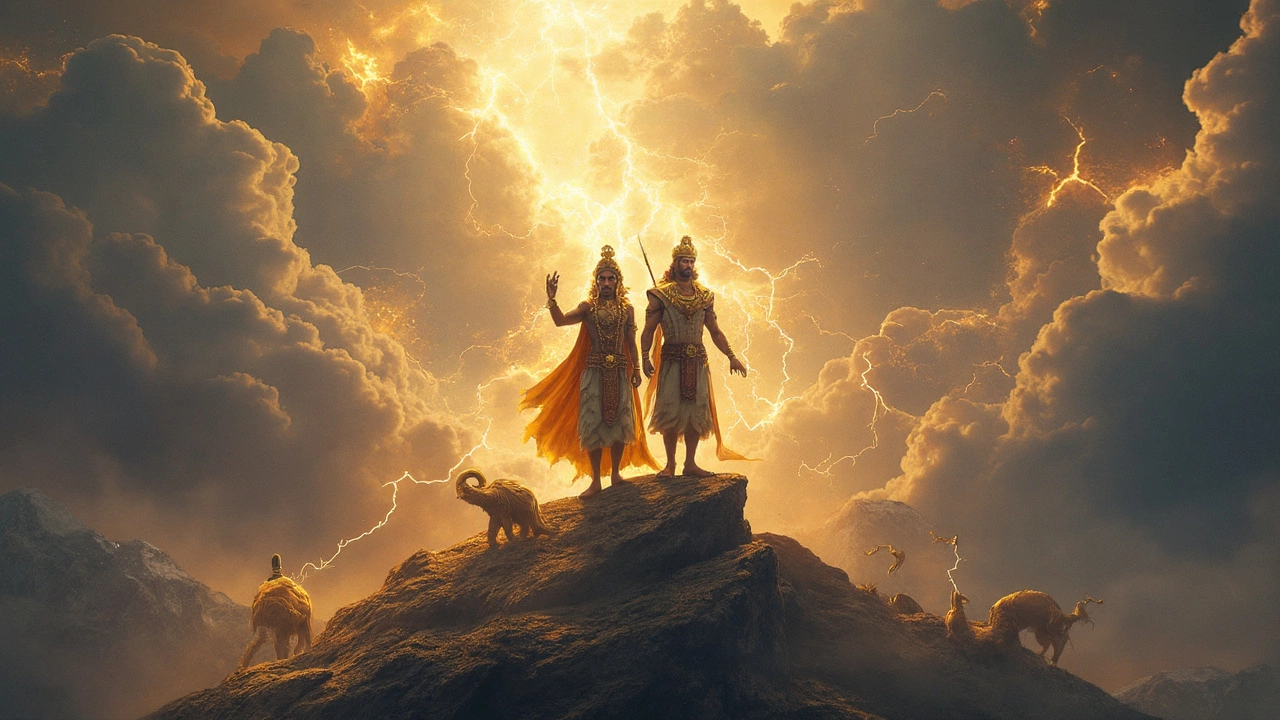
When you hear Zeus, the king of the Greek gods who controls thunder and rules from Mount Olympus. Also known as Jupiter, he represents power, authority, and the natural forces that govern human life. It’s easy to wonder if he has a twin in Indian mythology. He doesn’t. But that doesn’t mean the question isn’t worth asking. People often mix up Zeus with Indra, the Vedic god of rain, storms, and war, who wields the thunderbolt and leads the gods in ancient Hindu texts. Both are sky fathers. Both strike with lightning. Both sit at the top of their pantheons. But that’s where the similarities end. Indra’s power is temporary—he’s praised in the Rigveda but fades in later texts. Zeus? His throne never wavers. He’s the unchallenged ruler, the father of gods and men, the one who enforces cosmic order through sheer dominance.
Then there’s Shiva, the Hindu deity of destruction and transformation, often shown with a third eye and a trident, who dances the universe into balance. Some compare Shiva’s wild energy to Zeus’s temper, but Shiva isn’t a king—he’s a renouncer. He doesn’t rule through law or lineage; he dissolves it. Zeus has lovers, children, and councils. Shiva meditates in ashes, beyond desire. And while Zeus’s thunderbolt is a weapon, Shiva’s trident is a symbol of the three gunas—sattva, rajas, tamas—that make up all existence. You can’t swap one for the other. But you can learn from the contrast. Why did one culture build a god who demands obedience? Why did another create one who dissolves the need for it?
These aren’t just ancient stories. They shape how people think about power, justice, and the divine. When you see a Tamil temple carving of a god with multiple arms, or hear a Greek epic about a king who defies fate, you’re seeing two different answers to the same human question: Who holds the sky? The posts here don’t try to force Zeus into Hinduism. They show you where the confusion comes from—and why it’s useful to untangle it. You’ll find articles that compare divine roles, explain why gods are painted in certain colors, and reveal how folk traditions in India quietly echo themes found in faraway mythologies. No fluff. No forced parallels. Just clear, grounded comparisons that help you see both systems more clearly.
In the fascinating world of Indian mythology, gods from different pantheons might seem to share traits and stories. While Zeus is the mighty ruler of the Greek gods, he shares some similarities with Hindu gods, notably Indra, the king of gods. This article explores these intriguing parallels, focusing on their roles, powers, and stories to uncover how different cultures perceive divine narratives. By looking into their mythologies, readers can discover how societies explain the universe and human life through their gods' stories.